Science and extreme agendas

Author: Raf Kliber (Social Media Officer)

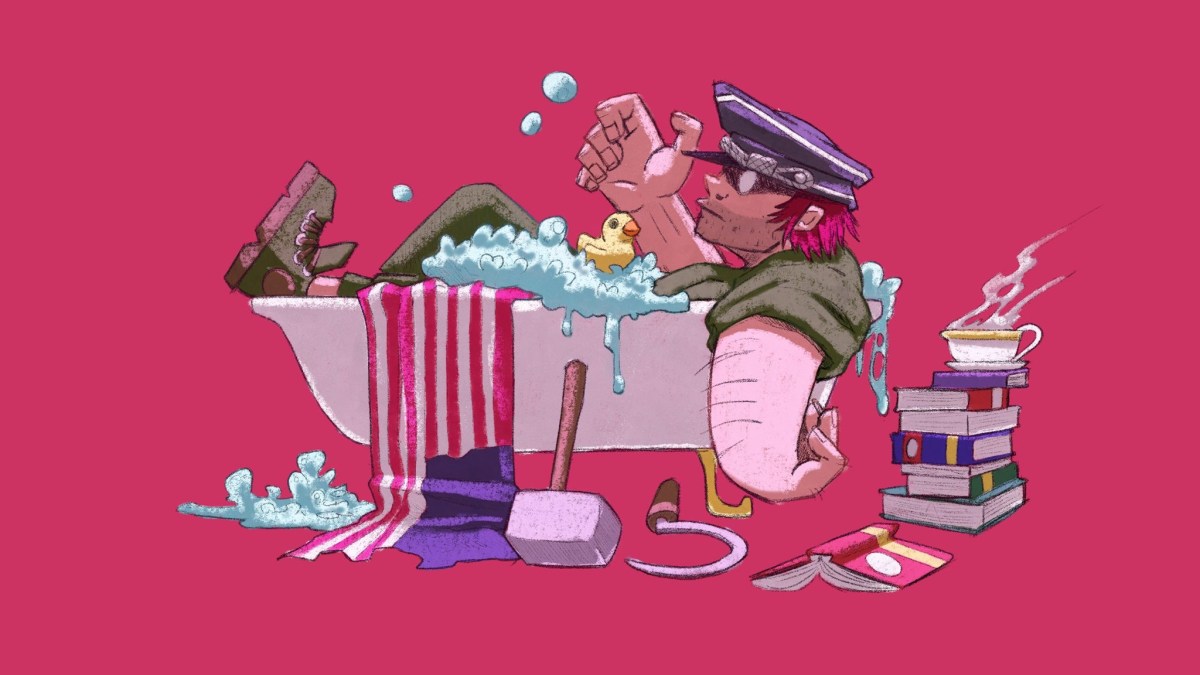
Original feature image art specially drawn by: TallCreepyGuy

While I work myself to boredom at a local retail store, I listen to some podcasts in the background. Something to cheer me up. Among my favourites are the Nature Podcast and Climate Denier’s Playbook. But, on that specific Wednesday, the episode was anything but cheering. I landed on the Nature Podcast’s “Trump team removes senior NIH chiefs in shock move” episode, which provided me with a bleak look into the current US administration’s proceedings. The bit that shocked me the most was how much the move clung to Project 2025‘s agenda. One of the moves discussed was a defunding of ‘gender ideology’ driven research (read anything that includes the word trans, even though such research is useful for everyone). Furthermore, instead of such ‘unimportant’ research, the administration wanted to conduct studies into ‘child mutilation’ (read trans conversation therapy) at hospitals. Eight hours later, while soaking in a mandatory afterwork bath, I began pondering “what is the interplay between extreme agendas and the ‘fall’ of science?” and “what I, a STEM person, could do about it?”. As a Polish person, my first bubbles of ideas started with fascism and the Third Reich.

Jews, fascism, and ‘directed’ science

I moved to the UK when I was twelve years old. This event spared me the traditional trip to Auschwitz one takes when in high school. It spared me from the walls scratched by the nails of the people trapped in gas chambers. It spared me from the place so horrible yet so pristinely preserved that visiting it is as close to time travel as one can get. About a fifth of the population of Poland was wiped out in World War II. On average, every family lost someone. Not on average, many families were completely gone. Due to the gravity of the topic at hand I reached out to Dr. Martin A. Ruehl, lecturer in German Intellectual History at the Faculty of Modern and Medieval Languages at University of Cambridge for some guidance. He also gave a talk on “What is fascism?” during the Cambridge festival, which I recommend. Another reason is that I am by education, a physicist, and just as physicists have their own set or rigorous habits that make their field solid, historians and philosophers have theirs.

Fascism as an idea is fuzzy, or at least with fuzzy borders. One knows definitely that after Hitler took over the power in Germany, it took on Fascist ideology. It is also abundantly clear that the current UK is not a fascist regime. Trying to nail the border delineating the least fascistic and just about not fascistic regime is futile, complicated further by each regime having their own unique element. The process of how it festers and develops in a country is left for others to explain, and I encourage the reader to watch this video essay by Tom Nicholas on how to spot a (potential) fascist. I will go with the conclusion of Dr Ruehl’s talk. Fascism is a racist, nationalistic, extreme and violent idea that often puts the core group in a self-imposed theoretical attack from the outgroup. (e.g. Jews were an imagined threat to the German state, even though they weren’t). I procrastinate talking about subject matter to highlight two important points: Fascism is a complex topic that could be studied for lifetimes and consequently, I am not an expert. I have made my best attempt at giving it the due diligence it deserves.

Disclaimers aside, what was the state of science during Hitler’s reign? Let us set the scene. The role I’d like us to play is that of a scientist at the time. Let us imagine ourselves in 1933 Germany, right at the beginning of the Nazi reign. Nazi party made it rather clear: Either you, as the scientist, are ready to conduct research that aligns with the party’s agenda, or you’re out of academia. Unless you’re Jewish and known to be on the left of the political spectrum (historical pre-nazi left, although it would still include things like early transgender care, for example, as advocated by Magnus Hirschfeld), then you don’t get a choice. Physics Today has a nice article that contains the migration of selected physicists out of Nazi Germany, which I recommend having a look at. Similar goes for other branches of science. The crux of the situation is that if you are studying races or ballistics, you are more than welcome to stay. Hitler did recognise that only the most modern military equipment would allow for the Third Reich to wage war on everyone. Similarly, he did want to put his ideals onto the firm foundation of “cold and logical” science, even though at times that compromised the scientific process. For example, the creation of Deutsche Physik (which denied relativity) and the burning of books by the above-mentioned Magnus Hirschfeld. (As much as my past self would thoroughly disagree, trans people are a cold and logical conclusion of how messy biology can be. More so than arbitrarily dividing all of population into two buckets.)

The adoption of the idea of Social Darwinism (that fittest social groups survive) and the knowledge of what genes do (albeit well before the discovery of DNA structure and the ability to compare genomes) created the foundation of ignorance for ‘scientific racism’ and eugenics. That being said, there was more to it than the current state of not-knowing. According to the introduction of “Nazi Germany and the Humanities” edited by Wolfgang Bialas and Anson Rabinbach, “Creation of the hated Weimar Republic created a deep sense of malaise and resentment among the mandarins, who, for all their differences, had in common the belief that a “profound ‘crisis of culture’ was at hand””. To draw a conclusion, the loss of the war and a tense national atmosphere led to the development of such völkisch ideals way before Hitler’s regime touched the ground. To further quote, “many retained the illusion of intellectual independence”. The general sense of superiority also gave rise to books like Deutsche Physik, a work that opposed Albert Einstein’s work directly.

(Note from the author: Googling “Social Darwinism” will lead you to creationist videos by Discovery Science (A YouTube channel by Discovery Institute, a fundamental creationist think tank). They seem to be hooked on using the aforementioned atrocities to try to link Darwin, and his early understanding of evolution, to Satan and hence to him leading us away from God with his theory. It is worth mentioning that although it bears his name, Darwin did not play a role in coining or using the term.)

To summarise this section: The way the corrupt ideals spread into science and politics in Nazi Germany arose from discontent and false hope. It was more of a fork situation. Both the world of academia and politics took up the story of national threat and superiority due to high levels of discontent originating from the Weimar era, and while intertwined together, I think that the cross-influence only amplified the process. This resulted in academia and politics taking up both ideals independently, and simply supported each other in the downward spiral such as antisemitism.

USSR, Russia, and limiting scientific cooperation.

A nice cup of tea on the following day led to some more thinking about other regimes. Like a true ‘Brit’, I took out my teapot and with a cup of Earl Gray in a fancy Whittard porcelain in my hand, I drifted off again into another rabbit hole. This time instead of west, I dug the tunnel east.
An interesting tidbit from my past regards my primary school. The changing rooms in that place had an interesting design. If one were to pay enough attention, they would see a system of grooves in the floors that were meant to act as drainage. Why drain something from an indoor location? The changing room was meant to serve as an emergency field hospital in case of another war. The school turns out to be old enough to see some of the old soviet practices in its design. For those unaware, Poland was part of the Soviet bloc up until 1991. Just 12 years before my birth, and 13 before Poland joined the EU. So let us journey to the east and see what history has to teach us.

Stalin was a dictator, just like his Austrian-German counterpart. What is slightly different is the ideology that shaped the persecution of scientists at the time –  a different flavour of extremism. I could go on a rant about what Stalinist flavour of Marxism is, but just like Fascism, there are scholars who spend their lives studying it. I am not one of them.

Nevertheless, the parallels between the corruption of sciences in Fascist Germany and Stalinist USSR are rather staggering for such different ideologies. In Germany, anything considered Jewish or going against the greatness of the Aryan race was immediately cut out, while the rest was bent towards the leading political party’s view. Here it was much the same. The humanist subjects took the largest hit in independence, as those in Germany. Lysenkoism played a role in slowing down the genetics research in the USSR. Instead, what followed was an increase in Lamarckism (acquired characteristics are passed on, rather than typical natural selection). This then, possibly, contributed to agricultural decline, creating another subject of memes for the edgy GenZ.

This also led further to isolation of the scientists. While every now and then they would invite foreign scientists (as Feynman wrote in his letters, and let us be honest, this might have been because of his involvement in Los Alamos) the mingling of Russian scientists with the rest of the world was minimal. Did I forget to mention that geneticists were often executed for not agreeing with Lysenkoism? Science is a global endeavour for a reason. It needs way more manpower than any country alone has. A country can never be a fully independent branch, it will simply lead to a slow withering of progress.

To have a nice circular structure in this section and bring it back to my home: Attitudes can also persist after occupation. The Polish government made some unpopular moves in academia during the time of the PIS party. Polish academia uses a scoring system, where each publication in a journal grants you points. Each point tries to quantify your contribution to a field. So technically a biochemistry paper would give you points in both biology and chemistry. They started awarding more points for papers in Polish journals rather than international ones, alongside some mixing of awarding points in political sciences for publishing theology papers. This may be seen as a slight resurrection of the national pride in sciences which I despise so much (Springer Nature’s journals are always going to be my favourite to skim through).

So what?

My Eurocentric summary of history is probably boring you to death. Let us talk about the US. Trump! The name that makes my hair stand on the back of my neck. The similarity of what is currently happening in the USA really makes me think that history does indeed repeat itself.

Firstly, just like Lysenko and his anti-genetics, Trump decided to elect RFK Jr as the minister of HHS. A well known opponent of vaccines is in a position of hiring and firing researchers. The MAHA (make America healthy again) report included a lot of less-than-optimal healthcare research directions. RFK really believes in a mix of the terrain theory (that the terrain of your body i.e. fitness and nutrition, play THE most important part of your immune system) and miasma theory (covered in a previous article here, but basically a medieval theory on bad air making you sick). There are a whole host of reasons for a person to also point out that a recovering drug addict and brain tapeworm survivor does not make for a great leader for a health agency. To be a devil’s advocate though, he did come up as an environmental lawyer. Additionally, RFK supports removal of fluoride from water and has helped to spread misinformation about vaccines in Africa. He has a very tangible body count and actively harms populations.

Secondly, there are the topics from the headlines in the first section. It is clear that the current administration’s aims are not simply doing science to explore x, but rather confirming x under the guise of science. This is why 75% of scientists that answered Nature’s poll said that they are looking to move out of the USA. Additionally, in a piece by the New York Times, experts in Fascism are also moving away from USA. It is something that is now consequently causing the ‘brain drain’ in the USA and, ironically for an administration that is anti-China, hands over the scientific majority to China. (Whether you think that is good or bad, is up to you. I personally am neutral.) Additionally, the administration has already tried to block Harvard’s ability to admit international students which contribute heavily towards their income stream – all in retaliation for Harvard allowing students to express their right to free speech and protest in favour of Palestine. This is slightly more sneaky than executions and imprisonments. Nevertheless, in a capitalist society, it might be somewhat equivalent when the funding we all depend on goes dry.

Lastly, there is a difference I would like to point out. Regimes like the one above often arose from a dire need for a radical leader and major changes. The current administration is exercising what I would like to call stealth authoritarianism (as coined by Spectacles here). Gone are the days of having posters with long-nosed depictions of minorities that eat children on every street (although the ‘they eat the dogs’ moment was close enough for many). The current US president is using rather specialised and closed off social media to reserve their opinions to their most dedicated followers rather than the general public. We live in the age where the algorithm separates us. It is becoming ever less likely to encounter an opinion we disagree with out in the wild without searching for it. Executions are no longer needed to silence the critics, for as long as you have a devoted fanbase, the infectiousness of the internet can create a potent and numerous enough group to win the election.

The fact that someone can be so overtly against reality, so blatantly corrupt, yet at the same time can feed a mirage to the right people to get elected is the true curse of the modern information landscape. For me personally, it is the main reason why CUSAP and similar societies are more important now than ever before.

What can you do

Every good opinion piece should end with a call to action. I also don’t want this entire blog post to be a long way of saying “AAAA WE ARE ALL GOING TO DIE!!!”, because we most likely won’t.

  • If you are in the USA and courageous enough, protest. It should be easy enough to find one nearby. This is not the main recommendation. Police brutality has already made itself visible in the past month.
  • What you can do more safely is support local lobbying. Be prepared that democracy is not as accessible as it seems. Genetically modified skeptic has posted their experiences trying to vote down the requirement for schools in Texas to have the 10 Commandments in classrooms. It was not a pleasant experience, but organisation and support for lobbying individuals can go a long way. Even if it means bringing them food and supplies or sitting in to notify them when it is their turn to speak at meetings.
  • Vaccinate your family against misinformation. The emotions can run high when politics are involved, but perhaps you can connect one bit of their viewpoint to that kernel of truth that may help. My personal jab at right-wing oil enthusiasts is to connect it with their dislike of migration, as this is a likely result of climate change. (Yes, I don’t believe migration is bad, but they do. Sometimes, you have to engage one topic at a time.)
  • Join a group to lobby and promote critical thinking. Here at CUSAP we try to go beyond Cambridge; thus we welcome articles written by non-members. You can get in touch with us at the https://cusap.org/action/. Youth against misinformation is another one. Plenty more can be found online.
  • Most importantly, do not shut up. Speak up when you see fake news. Don’t get distracted by trivial problems. Call your local political governors, meet with them, email them. This goes regardless of which party they are associated with. Make sure that they know that the truth is what you support. (It goes without saying, as long as you feel safe to do so)
  • Lastly, for my own sanity: do not be nihilistic about how little significance one action or vote has. One vote can make a lot of difference when it is surrounded by a couple thousand more singular votes.

Alpha (??) Male (???)

Author: Maya Lopez (Blog Chief Editor)

When I was video calling my parents recently, I noticed that a wildlife documentary was playing in the background. The documentary was on some pack of wolves and followed the tale of a dominant leader who got injured and left the pack, so the next oldest sister stepped up and led the pack. “Leader”. I was actually impressed by the up-to-date wording, reminded me of the story I saw a few years back on the term: “alpha wolves” – and how such outdated remains ingrained in our society.  But also, did the documentary just say sister stepping up as a leader? This led me straight back to the memory hole and some reading in between my deadlines, where I rediscovered the tale of science finding that was embraced by a culture, but culture/society refused to evolve with the scientific updates. Given the modern (and possibly unsustainable) rise of “manosphere” and loneliness epidemic, especially amongst young men (of course, while not uniquely exclusive to men) are believed to be linked to the current political climate and radicalization, we’ll explore where we got this “alpha male” myth often dubbed to be backed by “evolutionary science”. And this turned out to be an emblematic case where culture arguably sought after the label of “scientific” to affirm and add prestige to the social construct that some people wanted to desperately believe, and how this is much more difficult to falsify and update than actual scientific facts.  

“Alpha wolves” finding and its correction status

So, where did this all begin? It is no coincidence that alpha-male to this day is often represented as a wolf emoji, as seen on Wikipedia. 1971, L. David Mech , a zoologist specializing in wolves, observed that a strong dominant wolf seems to be leading a pack. And he published his findings in a book called “The Wolf: The Ecology and Behavior of an Endangered Species”. I couldn’t find the exact record of how many copies were sold, but it had numerous reprints and digital releases until it got taken out of print in 2022.  This is perhaps a testament to its influence in all these years in the competitive world of publishing, and essentially popularized the terms alpha wolves, so I think it is fair to say that the book was super well-received in public. Personally, I think this level of success with science communication in itself is indeed remarkable. Perhaps, being the 1970s when eco-consciousness was on the rise and even “Earth Day” was born from a public movement, the conversation about ecology and endangered species was at the right time. However, the cultural impact (unfortunately?) lies well beyond the realm of ecology, leading to the connotation of this term to characterise a specific imagery of wild, dominant, aggressive (?), masculinity throughout the upcoming years.

The book outlines various facets of studies in wolves across different chapters- from their wild life distribution to the pack structure. The term alpha was introduced in a context to describe an apparent leader in a pack that seemed to have achieved its status by dominating others in the pack. Interestingly, this term was used in a similar sense in a report published in 1947, Germany, so Mech’s book arguably stemmed from a long lineage of academic writing that held this prevailing theory of a wolf pack hierarchy. Also fascinatingly, “beta wolves” in this context is de facto #2 in the group (quite a different nuance from modern internet slang, but I’ll get back to this in a sec). But there was a big caveat to all of these studies: they were based on wolves under captivity – an artificial setting, often with individuals of non-blood relatives boxed in the same environment. So while “alpha wolves (and corresponding female pair)” emerged in captivity, when researchers expanded their search and saw if this is also applicable to their natural state, things went awry.

Like in many natural science findings, the alpha wolf finding was actually corrected and updated in a later decade. In fact, the interesting thing is that this falsification came from Prof. Mech himself (in what I call a true scientist fashion)! Upon his further investigation of wolves, he discovered in the 90s that the natural wolf hierarchy is, in fact, just a family. In this context of kinship, bloodshed and battle for the dominant position were rare. In an interview piece from New Yorker, an associate research scientist with a National Park Service research program in Yellowstone,  Kira Cassidy sums up the current notion of the “wolf hierarchy”:

“It’s not some battle to get to the top position. They’re just the oldest, or the parents. Or, in the case of same-sex siblings, it’s a matter of personality.” 

It’s easy to imagine how parents, naturally older and more experienced, lead the pack, and their offspring follow their lead. Mech himself was one of the most vocal proponents to refrain from using the term alpha wolves because “it implies that they fought to get to the top of a group, when in most natural packs they just reproduced and automatically became dominant.” In ‘99, he tried to describe these parents as having “alpha status”, and eventually the field stopped using the term altogether. If you check the International Wolf Center webpage today, you’ll see it being described as “outdated terminology”. Modern research also finds that in natural reserves where pacts occasionally fight for territories, they can observe rather extensive pacts, including aunts and uncles, and multiple “breeding pairs,” making the structure more flexible and less hierarchical. Furthermore, even these leader positions are essentially not about aggression but rather more about responsibility, and submission is more of a chain reaction mannerism rather than an all-hail-and-serve-the-dictator attitude. To quote the Scientific American’s article, “The youngest pups also submit to their older siblings, though when food is scarce, parents feed the young first, much as human parents might tend to a fragile infant.”

When culture decides not to update based on new findings

So okay, alpha wolves weren’t really a thing unless you split up families and smush them into the same room, and natural leaders aren’t really about aggression and bloodshed. If this tale were as famous as the concept of the alpha male, then it would’ve been a great example of scientific falsification updating the societal norm, but that was not the case. What starts the application of the concept/term of alpha to humans is arguably NOT the wolf book I mentioned earlier, but the book published in 1982 called Chimpanzee Politics: Power and Sex Among Apes, where the author implies that his observations of a chimpanzee colony could possibly be applied to human interactions. But the thing is this term was still mostly in ecological contex (and not applied to discuss human interaction) till around late ‘90s where on top of the wolf example described above (which gives the pack leadership imagery), it also applied in other non-social animals, particularly to refer to male’s mating privileges due to their ability to hold territory, win food consumption, etc.

Then, who popularized this chimp/wolf term to describe a human male? I couldn’t access the actual source article that did this, but it was mentioned in Wikipedia that around the early 90s is when alpha referred to humans, specifically to “manly” men who excelled in business. But the recorded most pivotal moment in (pop?) culture is perhaps the ’99 American Presidential election campaigns, incidentally the same year Mech denounced the alpha wolves concept.  According to journalist Jesse Singal, from New York magazine, the word entered the public consciousness on a mass scale that year when a Time magazine article published an opinion held by Naomi Wolf, who was an advisor to then-presidential candidate Al Gore.  The article describes Wolf as having “argued internally that Gore is a ‘Beta male’ who needs to take on the ‘Alpha male’ in the Oval Office before the public will see him as the top dog.” Naomi Wolf herself, for context, was a prominent figure in the third wave of the feminist movement, with publications like The Beauty Myth in 1991.  But from around 2014, journalists started to describe her reporting on ISIS beheadings, the Western African Ebola virus epidemic, and Edward Snowden as containing misinformation and conspiratorial, and in 2021, her Twitter (… okay, “formerly-known-as-Twitter”) account was suspended for posting anti-vaccine misinformation. Her Wikipedia page now includes a title: conspiracy theorist.

Singal also credits Neil Strauss’s 2005 book on pickup artistry for popularizing alpha male which sedimented the aspirational tone of the alpha male as a status, but I think the pattern is clear: a frankenstein mish-mash of an outdated scientific-concept (literally, revived from death if you think about how the term was dying out in wolves research) and some vague sense of aspirational male figure that encaptulated the “cool” of the era has entered the lexicon, carrying the prestige of “science word” (not entirely untrue but leaving out the many big caveats mentioned above). And once things become a culture, it is hard to change, despite culture, if you think about it, is inheretaly in constant flux in the history of homo Sapiens. I’m not saying all cultures are bad; certainly not: it’s collective behaviors that have adapted throughout history. However, we often use “well, that’s the culture” as a reason to defend practices even after we, as a society, gained the means and the knowledge on how wrong or even harmful some things could be.

The correction status of alpha males (?) in other species

But wait, did you notice how this conversation of dominant status eventually became specifically about dominant “male” status? Where in the world did our social image of the alpha male even come from? Ultimately, it seems that we didn’t want to dismiss this idea of the almighty dominant male. Even to this day, if you Google “myth of alpha male,” you can find Reddit threads with comments that “acknowledge” that it is outdated and untrue in wolves, but people often ignore the male dominance found in Great Apes. Sure, male dominance CAN be a thing in great ape like Gorilla silver backs I guess (but note they get their own fancy title), but the implication made here seems to be that “wolves don’t matter because wild life closer to humans shows alpha males so we human males should also have alpha nature too errrr”. But what if the underlying assumption about the domineering male in relative species… does not hold as well as you think?

So let’s go back to our assumption about relative specie chimps and see if the assertion from the 80s holds true. Long story short, once again, like in the context of wolves, it turned out the scientific reality is more complex than the earlier rendition of it. Chimps are social creatures, like wolves and humans, and, indeed, there is often an alpha male in a group with mating privileges. But dominating other males with power and bloodshed turned out to be not the only way to achieve the top status – one can groom their way to the top. 2009 research found an interesting correlation with different males and their “styles” to achieve their status. Essentially, they saw that smaller chimps with perhaps less intimidation power compensated for this by grooming other members more frequently and equally. This also speaks to the complex nature of the alpha status too: they’re also judged by the other members of the group – in effect, being a popularity contest rather than a pure dictatorship. So while alpha male is a thing, it does not have to be the pure aggressive type that we typically imagine, and the stereotypically “beta-moves” might totally be his strategic winning move.

Let’s also interrogate the other half of the phrase: does it even have to be alpha “males”? Our other equally close relatives, Bonobos, will tell you otherwise. They, in fact, are often termed a matriarchal society for often being led by an experienced female senior(s) as a leader in the wild. In such enviornment, a routy and aggressive male that gets too excited by a presence of fertile female in fact can get his butt kicked – or more like toe bitten off in the extreme case by the experienced females who might gaurd such young female. This was the case for the group of bonobos in Wamba forest in the Democratic Republic of Congo, and his social position in the group plummeted. While the toe-bitten level of fight back is unusual, Dr. Tokuyama describes that “Being hated by females … is a big matter for male bonobos,” as the alpha male attitude here giving unwanted & violent sexual provocation is often met with a strong resistance by the females who woud band together to fend off such behavior.  As a homo Sapiens, I can’t say that this an-eye-for-an-eye tactics lending itself to violence is ideal, but, it is interesting to see an entire specie dynamic where aggression of male that evokes alphaness is arguably seen as reckless, meeting a stong resounding: NO.  

Can we finally update our alpha-male myth?

During my teenage years, I almost got the impression that alpha/beta categorization is increasingly becoming… cringe – a hype, a target of satire that became no longer cool upon oversaturation in the internet lingo. But the modern narratative around manosphere, while not mainstream (… I hope), is hinting otherwise. The very definition of masculinity for some people is somehow seeming more aggressive, dominating, and hierarchical. While such views may have always existed to some degree, highly visual-focused trends nowadays seeping into youth culture are perhaps accelerating this issue in a possibly dangerous way.  Perhaps alpha-male is too catchy, too photogenic, too trendy at this point to go out of fashion overnight (and in fact, during research, I found it immortalized & perpetuated in courses, coachings, and AI characters!).  And you know, as a story archetype (and possibly some people’s …let’s say “romantic type”), I can see some point – but maybe we can leave that to the realms of Wattpad’s Twilight spin-offs.  And I feel something inherently sad about reducing complex human social behaviors and the multidimensionality of personality we can have as REAL individuals to be reduced to a simple slogan and the law-of-the-jungle type of mindset, all with an undertone of violence and a dog-eat-dog world view.  

With simple slogan perpetuates a simple view of the world; an easy pill to swallow compared to a mentally demanding task of critically assessing social constructs.  After all, we are all facing a historic level of exhaustion and work demands. However, next time a trendy catchphrase from a view “supported by (evolutionary) biology” creeps up into your feed, let us ask ourselves, what complexity are we removing and at what cost?  Constant refrain from a critical reassessment of our own culture around us could quickly spiral true subordination of mind, ripe for exploitation (…thus very un-alpha if you ask me).  So let us practice our critical thinking and be wary of narratives that sound too… black-and-white.  Maybe science can help you update and be more flexible with thinking, because hey, science is ultimately unafraid to evolve and update, and so can we.


Nessie – can scientific investigation ever deny cryptid?

Author: Maya Lopez (Blog Chief Editor)

Walking up to the shores of Loch Ness, I saw a body of water that quickly turned black just about 5m away from where I stood. This was not surprising given that this Loch is deep: the deepest point being 230m, housing a volume of water across the entire British Isles. However, the exceptionally low visibility of the water is not only due to the depth but also to its high peat content running from the surrounding land. Noticeably, I didn’t (happen to) see any fish, consistent with the current scientific understanding of the Loch’s biodiversity.  Biodiversity is said to be low due to the low plankton counts (probably due to the low visibility interfering with their photosynthesis). But all these things aside, it was clear that Fort Augustus, the small town of 650 residents, was full of visitors today, here to view the Loch, not necessarily for its serenity and the unique geography, but for its pop culture icon. And if they are lucky, to spot the next sighting of the cryptid known across the world: The Loch Ness Monster.

The iconic long-necked Nessie from the ‘30s:

The Loch Ness, believe it or not, only gained such worldwide attention within this century. The first publication that generated a wide audience was the testimonial of a local hotel-owner, the Mackay couple, on April 15, 1933. It described the sighting of a rolling “beast” or whale-like fish.  Soon after, in August, another report was published describing a sighting of a beast by George Spicer while driving by the Loch. This description was more vivid: the monstrous creature, resembling a prehistoric dinosaur, crawled back into the water. While the myth of the monster in the Loch has existed from ancient times (as far back as the 500s, where some versions of the tale include St. Columba combating a monster from this loch), a lot of the oral tradition included a more vague concept of a monster. However, the articles from the ’30s (and the widely popular movie at the time, King Kong (1933), which featured a long-necked dinosaur-like character, “possibly inspiring” these early sightings) started to capture the audience’s imagination on what this monster may look like. However, arguably what semented this monster’s visual is the most well-known photograph of the said cryptid: “the Surgeon’s photograph”. The iconic image that probably most of you imagine (a long neck, shadowy figure in clear waves of water) was published on April 20th, 1934, in a British newspaper as a submission of Robert Kenneth Wilson, a gynaecologist in London. When I popped into a souvenir shop, I found very few items with this re-print. While I got myself a shortbread pack with the closest resembling photo (who could resist!), THE photo was nowhere to be found. Was this just because of a copyright issue? …or is that photo, say, already known, to be NOT an actual Nessie?

Debunking and scientific investigations (?) of Nessie

For some reason, the lack of the iconic photo-merch bugged me more than the Nessie-less views of the Loch. Truth be told, I had zero expectations to see the cryptid itself, but I was hoping to indulge in historical pop-culture references that enchanted the world for nearly a century! Maybe I should have gone straight to the Loch Ness museum, but the drive this north from the hotel left us with limited time. So, I did some extra reading (online) and found out that my suspicion was right: that famous photo was, in fact, (alongside many pieces of evidence) debunked. “The Surgeon’s photograph”, in fact, was not taken by a surgeon at all. Instead, it was created by M. A. Wetherell, who had previously submitted and was denied the evidence of “Nessie’s footprint” by his employer, the Daily Mail. He planned a revenge in which he crafted the cryptid’s head and neck with wood putty and attached it to a toy submarine. This photo was then taken, which later investigation also revealed to have been cropped to manipulate the impression of size. The picture was then handed to his friend doctor, who then later sold the image to the Daily Mail, resulting in the publication. This (Wetherrell’s) Nessie was apparently sunken and is still possibly somewhere deep in the Loch today.

Many other pieces of evidence were also later debunked upon reinvestigation. The Taylor film from 1938 was found to be a floating object instead of an animal in 1961. Similarly, Perter MacNab’s photograph was analyzed either to be a misinterpreation of two consecutive waves forming a hump like shadow, or an intentional hoax. While much of the investigative efforts seem to have been going to primary dissect each and every notable sighting image, footage, etc (and mostly refuting them), there has also been some genuine “scientific exploration” that took place. The first one, being within a year after the notable siting in 1934,  Edward Mountain commissioned the first large-scale search with 20 men. With binoculars and cameras spread across the Loch, the investigation continued for 5 weeks, and yet no conclusive images were taken, with one film (now lost) may have possibly shown what appeared as a grey seal. By the 60s, the Loch Ness Phenomena Investigation Bureau (LNPIB; later shortened to LNIB), a UK-based society, was fully established to investigate the Loch to identify the Loch Ness Monster or determine the causes of its sighting reports. They launched their first expedition with a whopping $20,000 grant from World Book Encyclopedia to fund a 2-year investigation during the days of May to October, resulting in area coverage of about 80% of the loch surface. Despite their search effort consisting of 1000s of members, including self-funded enthusiasts and successive sonar investigations, once again, nothing conclusive turned up. However, the sonar apparently picked up an “unidentified object” moving at 10 knots per hour, too fast for a typical fish. Such “possible leads from scientific investigation” definitely fueled the enthusiasm, but the advanced technology soon stacked more evidence against the existence of a prehistoric cryptid. In 2018, believe it or not, there was a DNA survey to search for any “unusual species” that could be indicative of an undiscovered cryptid. Surprisingly, no large fish or animal (like a seal) DNA was also found, with the biggest fish being mostly of an eel. This suggests two plausible (?) ideas that 1) there’s a mega eel (somehow never caught) or 2) a large amount of eel DNA traces accumulated from many small eels. Nevertheless, the researcher commented that “we can be fairly sure that there is probably not a giant scaly reptile swimming around in Loch Ness”.

Can Nessie invite you… to Biology?

These examples, while perhaps a killjoy for prehistoric cryptid seekers, are still a fascinating and illustrative example of biology and the science of ecosystems. Another of my favorite estimates suggests that for one of the most popular theories of the Loch Ness monster being an (ancient) humongous reptile to be true, at least 25+ individuals are needed to sustain its species. This “scientifically fleshed out” theory poses several problems where 1) it is estimated that the Loch can only sustain about 17-24 tons of fish (due to the low plankton count we talked about!) which would limit any large carnevours animal over 200-300kg to be up to 10 and 2) If it was a raptilian specie, they will need to breath which should result in much more frequent sighting as the cryptid. Overall, it appears that most scientific consensus of our knowledge of reptiles, ancient dinosaur species, and the Loch’s ecosystem conflicts with the presence of such a cryptid. In fact, the more seriously you consider it, the science says “highly unlikely”.

However, highly unlikely (the best denial science can provide against things that…doesn’t exist) according to peer-reviewed, consensus-driven scientific conclusion, does not stop enthusiasts from asking “what if”. Which I suppose is understandable, and ultimately, they have the freedom to think so. Some hobbyist investigator has claimed that he was able to find more plankton than what people typically assume, claiming that this would equate to the possibility of larger life! (But did he account for the waves/wind that could cause uneven distribution of planktons?)  Falsification spirit in itself is perhaps scientific, but ignoring all the other evidence that points against it is not so much. Personally, I find a lot of these science-based theoretical calculations of how many large cryptids we would need to sustain a species, or the possibility of large eels and waves from the unique geography much more fascinating.  However, then I started to wonder: why do we keep searching for THE THING that the evidence continues to be stacked against its existence? Ultimately, perhaps we (or some of us anyway) want to believe. And this want is so large that we are driven to go back to the drawing board again and again. Or perhaps it’s the romanticism of the unknown itself – to find the thing the elite academics have been saying wrong all this time and proving the underdog right. Or maybe it’s goodwill, and we don’t want to believe that people are lying intentionally. …Or maybe… it’s too expensive to let this story be completely banned at this point.

Either way, it is safe to say that there is no scientific consensus backed reasoning to suspect that a large, prehistoric-looking creature is in Loch Ness. However, I also started to come to terms with the fact that a lot of us are just enjoying the story of it all, and perhaps even the back-and-forth effort of proving and disproving.  Ultimately, this cryptid is arguably loved and needed by the town. Science, unfortunately, is often an expensive affair (especially the more resource-intensive conclusive approach like emptying out the Loch, for example), and a strong public interest is always a key to funding. If I were tasked to investigate when there is no scientific “reason to suspect” it exists, I personally can’t justify myself for putting my money and labor into it. However, while this might be wishful thinking, such tales can be leveraged to spark a more general scientific intrigue, perhaps enticing the cryptid hunters into other biodiversity citizen science projects even before they know it!  Furthermore, science doesn’t always have to be the killjoy denying fun, by encouraging people to challenge the convention (especially if it’s getting outdated). In that spirit, perhaps the High-Tech 2023 90th Anniversary Search is justified (albeit with willing participants). I think I’ll wait to pull out my bionoculars until National Geographic approves a photograph of Nessie (with a bounty of a million pounds) and entrusts the enthusiast to keep a watch for us.  Ultimately, while unintuitive for non-cryptid believers like me, Nessie investigations might just prove itself valuable as a great science public-engagement opportunity to fascinate a wider audience with the latest science investigation methods (often otherwise too technical and niche). Who knows, the kid walking out of the souvenir shop with the Nessie plushy might just gain enough intrigue in investigating the Loch under the lenses, and one day be the next scientist to find a much cooler Nessie in the water of Loch Ness under the microscope 🙂

Houdini – the OG debunking influencer?

Author: Maya Lopez (Blog Chief Editor)

Dealing with pseudoscience propaganda and facing the limitations in “debunking” approaches are our usual days here in CUSAP, but I started to wonder when did this “debunking” became a thing as we know it? As many of us share the sentiment, this day and age seems like a misinformation paradise with so much internet content with suspicious scientific evidence spreading virally. On the other hand, there are numerous content that attempt to fact check or “debunk” – pointing out the error of the information and exploring the actual science relevant to the topic -. These contents are often done by experts themselves – from cosmetic chemists addressing the suspicious beauty science to notable science communicators addressing exaggerated negativity towards science, or even discussing the “too ambitious attempt” to reinvent basic math. And these contents do pretty well, to a point where I’m sure it can be recognized as a whole genre. According to the Wikipedia page on “debunker” (yes, that’s the thing), one of the most ancient examples goes back to Cicero who “debunked” divination through his philosophical treatise published in 44BC. However today, I want to share a story of one name that keeps appearing in the modern section and gets referenced by multiple other notable debunkers: Harry Houdini. Pop culture icon who is well recognized through the various references from Kate Bush’s pop tune to J-drama Trick, to this day – Erik Weisz is a magician and an escape artist who is arguably the first celebrity debunker combating pseudoscience.

Houdini the medium buster and his influencer style feuds and drama:

In the 1920s, when he started to go full ham against spiritualists (which was a popular movement at the time – understandably being the time of grief for many people who just experienced WWI), he was already a well-known magician for nearly two decades. To be fair, stage magicians were apparently known to do these mystic debunking from the late 19th century, but his celebrity status, his continuous pursuit, and his “feud” with notable spiritualists and famous figures arguably brought the spotlight to these debunking at an unprecedented level.

He was a magician by trade, which allowed him to easily identify tricks the fraudulent mediums employed which fooled even scientists. In fact, such abilities shined when he was a committee member of Scientific America in 1922 which held an international competition to find scientific proof of ghosts, offering $5,000 to any psychic and medium (yes really) who could stand the tests of scientists. It was a legitimate attempt on the “modern science” against wildly popular psychic mediums. While many mediums shied away from the public test, some took the challenge. However, Houdini exposed these cases as a fraud.

Notable psychics (and their tricks) vs Houdini:

mediumassertion of the mediumtrick
George Valiantine of Wilkes Barre, Pennsylvania.Predicted aliens to visit Earth in the 1920s. Can communicate to spirits through a séance.Physically left the seat in the dark and touched the seance attendees as a “touch of the spirit”.
Mina Crandon, aka “Margery”From communicating with the dead via séance sessions and materializing “telepasmic hands”. She also claims to have been producing (?) “ectoplasm”.He actually debunked her in two of her séances each time trying to convey rest of the committee that she has been physically moving to “show the sign of ghosts” (via bell ringing, etc). She is one of the most notable figures he “combatted” so definitely check it out if you want to know the whole fiasco.
Joaquín Argamasilla, aka “Spaniard with X-ray Eyes”Clairvoyance; can therefore “read” numbers/dice within a box.Houdini specifically revealed that he was peeking at the number through a blindfold and a small lift of the box lid.
Nino PecoraroHas a deceased medium guiding him. Can make instruments play without touching.Houdini and others suspect him to be escaping rope ties and actually manipulating instruments. → events prevented via impromptu tightening of rope leading to a later confession.

As he further became a renowned medium-buster, Houdini further pursued his cause by going to séances undercover with a reporter and a police officer, further exposing what he deemed as nefarious activities that are “defrauding the bereaved.” While these continuous and successful debunk of notable psychics of the time can be seen as a feud on its own, perhaps the most notable feud is between a celebrity author, who you might not suspect to be a strong patreon of “unscientific spiritualism” when his most famous work is the Sherlock Holmes series…

Sir Arthur Conan Doyle thinks Houdini’s supernatural, while H.P Lovecraft co-authored denunking essay:

In fact, many of the notable medium tested in the Scientific America committee was brought in by the choice of none other than Sir Arthur Conan Doyle himself. While he is known for his medical degree and beloved for creating the epitome of the rational-detective archetype: Sherlock Holmes, he himself was deeply spiritual – beliefs ranging from communicating to the dead through séance and fairies.

Houdini and Doyle were initially friends, but Houdini’s persistent attitude against spiritualism eventually pulls them apart. Doyle would even invite Houdini to his house where his wife and self-acclaimed medium performed “automatic writing” to communicate to Houdini’s dead mother – only for Houdini to sit through hours of the session and only then reveal that all those 15 pages of English message in perfect grammar can’t be hers as she is not even fluent in English-. Furthermore, his debunking of Margery – who was unlike other publicity-seeking mediums and Doyle trusted extremely – caused a new suspicion on Doyle: what if Houdini is the most powerful medium? Doyle started to believe that all his magic acts were well…in fact magical and any medium performing in front of him failed because he was blocking their powers through his supernatural abilities (should I write a piece of Aurther the OG conspiracist?). Houdini was hoping that Doyle would realize that this was not the case, and one day invited Doyle to his mansion where he “performed slate-writing” – a method medium often used to supposedly communicate the message from the dead through unguided writing -. He essentially performed a magic trick, hoping to disillusion his friend with the following message:

Sir Arthur, I have devoted a lot of time and thought to this illusion … I won’t tell you how it was done, but I can assure you it was pure trickery. I did it by perfectly normal means. I devised it to show you what can be done along these lines. Now, I beg of you, Sir Arthur, do not jump to the conclusion that certain things you see are necessarily “supernatural,” or the work of “spirits,” just because you cannot explain them….

From 2006 biography: The Secret Life of Houdini (Atria Books)

However, Doyle’s belief was firm and their fallout only became a matter of time. Nevertheless, Houdini continued to pursue his fight against spiritualism and found notable collaborators (after death anyway,) along his journey. Houdini hiers  H. P. Lovecraft – now renowned creator of the cosmic horror genre, Cthulu lore in his own right – and his friend C. M. Eddy, Jr., for a project on a book to debunking religious miracles titled: The Cancer of Superstition.

Debunking of his lifetime:

Perhaps most famously, his final “evidence” against spiritualism was ultimately upon his death. He had told his wife – Bess – in advance a secret code which he promised that he would deliver whatever it took after death if such a spiritual realm existed. This approach – is not only romantic – but is arguably quite a scientific one in its philosophy (albeit not bulletproof). His hypothesis was there are no ghosts and an afterlife of the spiritual realm that can be contacted. So he sought to prove that by setting up a risky test (even though mediums may very well attempt various fraudulent techniques) which if mediums succeed, would disprove his theory suggesting that the spiritual realm is real and can be contacted. Perhaps this can be seen as his last glimpse of hope that somewhere out there a true medium can prove him wrong and the world of the dead actually exists to everyone’s comfort. Or perhaps he intuitively understood the need for a risky test and that he could only be certain of their fraud through an active attempt to disprove his theory.

Either way, while Bess encountered some attempts of fraud (which was later exposed), she did not encounter a genuine instance where the message: “Rosabelle believe” came through. 1936, after the one last unsuccessful séance on the roof of the Knickerbocker Hotel, Bess put out the candle that was burning beside a photograph of Houdini since his death. Later she is noted to have said “Ten years is long enough to wait for any man,” ending her search for one last voice from her loved one.

Legacy of debunking and backfire effect:

Houdini – as one of the OG celebrity debunkers – immediately shows his influence. Even in his days, apparently, multiple magicians followed suit: The Amazing Randi, Dorothy Dietrich, Penn & Teller, and Dick Brookz, to name a few. Furthermore, his debunking certainly remains iconic to this day inspiring modern debunkers across the world both in real life and as a fiction archetype.

However, I think the bright “success” of Houdini also illustrates the inherent limitations of debunking. Despite his debunking of individual mediums, for example, this does not necessarily put an end to the whole spirituaslim trend at the time. This itself is perhaps inevitable, but I think it speaks to how easy for “made-up” and pseudoscientific claims to proliferate while debunking one by one will always be a game of catch-up. The proliferation is perhaps unstoppable so long as the interest is there as a trend. Furthermore, it can be argued that the debunking also fueled the trend to some extent. It made a whole spectacle out of debunking and the harder you criticize the fraudsters, the “true medium” somewhere out there will seem ever more so valuable and coveted.

Finally, the relationship between Doyle and Houdini envokes the backfire effect – which is warned in the Debunking Guidebook (yes this is also a thing!) where if the message by the debunker spends too much time on the negative case, if it is too complex, or if the message is threatening – it can only strengthen the belief of those you are trying to debunk. The slate-writing magic performed by Houdini for example seems emblemeatic. Perhaps Doyle felt “threatened” (whether knowingly or not) about his intelligence as his message essentially was that just because you couldn’t understand the mechanism it’s not supernatural. Or maybe it was a more direct threat to his motivated belief – where Doyle’s attachment to the idea of the “spiritual realm” was much stronger than that of Houdini to a point where he couldn’t just let it go. Or perhaps not explaining how this trick was done (as Houdini often guarded his magic tricks and their IPs inevitably as part of his magic career) acted as a barrier and the final proof required to rule out the possibility that Houdini is actually supernatural.

Regardless of whether Houdini’s tactics and debunking are the best approaches against the modern pseudoscience epidemic, it is an interesting lesson that we can learn from the past. Perhaps there are no “perfect cure-all” tactics but let us all embrace our inner Houdini and wear our skeptic hats when presented with phenomena unexplainable by modern science. While supernatural and occult have their own charm (I’ll admit it, who doesn’t love good ghost hunts and mysteries!), let us consider if some of such explanations would feed into “defrauding the bereaved.” And at those moments let us be as brave as Houdini and be willing to stand our ground to say no, and propose an explanation that is as scientific as possible.

Featured Sources and recommended reading:

I hyperlinked most sources but here are a few that might be of your interest 😉

Scientific American Artilces:

https://www.scientificamerican.com/article/houdinis-skeptical-advice/

https://www.scientificamerican.com/article/scientific-american-vs-the-supernatural/

The debunking handbook:

https://skepticalscience.com/the-debunking-handbook-redirect-page.shtml

→ fun video on the mysterious death of Houdini (and his extent of debunking mystics)

The Tuskegee Syphilis Study: How “science” betrayed us & haunt back 50 years later.

Author: Maya Lopez (Blog Chief Editor)

The year is 1966. A 29-year-old American epidemiologist, Peter Buxtun filed an official protest with the Service’s Division of Venereal Diseases. He overheard a conversation with his colleague about a man whose family traveled a long distance to see a doctor, away from their hometown. The man was diagnosed with tertiary syphilis – a later stage of infection that damages the central nervous system – and was given a shot of penicillin. However, when the Public Health Service heard of this treatment, they were enraged as the unknowing doctor treated a “research subject” – from the Tuskegee Study -.

The epidemiologist found this rather… strange – why would you NOT treat a clearly ill individual at his later stage of symptoms when you have an effective treatment? After reviewing nearly 10 roundup reports, he realized the horrors of the supposed  “research”.

“I didn’t want to believe it. This was the Public Health Service. We didn’t do things like that.” 1

He knew that something had to be done. He consulted the literature on German war crime proceedings and the Nuremberg code and wrote a report comparing the CDC work to that of Nazis. This didn’t fly well with his bosses – seen as merely a complaint from an “errant employee” and shortly dismissed on the basis that the “volunteers” had full freedom to leave whenever they wished and this “serious work” was not complete. But isn’t the problem the fact that such a study is taking place? November 1968, a few months after the assassination of Martin Luther King Jr., Buxtun filed another protest. This is no longer just an ethical critique within epidemiology. This harbored political volatility. For the first time, officials realized how this case may have severe political repercussions, but once again, the claim was rejected.

So in 1972, Buxtun took a step beyond internal protest and became the whistleblower, bringing the story to Jean Heller of the Associated Press. The expose of the study was first out in the Washington Star and by the following day, it made its way to the front cover of the New York Times.  And this was how one of the most notorious, modern medical research finally came to an end – after 40 years of deception and harming of unknowing participants. Incidentally, this can be seen in light of the “self-rectifying” capabilities of science – the nightmarish research conducted in the name of science was rejected and ultimately taken down by a scientist.  And yet, in 50 years, this very pseudoscience that was rejected was resurrected, only to fuel more pseudoscience….

The Tuskegee Syphilis Study

So what exactly took place in Nazi-like research atrocity that was conducted in the name of medical science?  Tuskeegee is a city with a university in Macon County, Alabama, USA. The study started in 1932 and consisted of 399 Black men, who already had contracted syphilis and 201 of those who had not contracted it yet. However, these “volunteers” were not told what they were signing up for. In the midst of the Great Depression when medical care was already hard to obtain in this rural region, the Public Health Service and CDC in cooperation with local academic and medical authorities like Tuskegee Institute (now known as Tuskegee University) advertised a social medical roll-out program with following benefits: free physical examinations accompanied with rides to and forth the clinics, hot meals on examination days, and treatment for some minor ailments and injuries. It also had an added guarantee that their family would get recompensation if they agreed to an autopsy of the body after a series of medical studies.

This is particularly compelling in the context of the Great Depression and how male breadwinners have additional incentives to help with family financially. But for those who wondered if this could be too good to be true, there was added encouragement from the already trusted local authorities within the community (like pastors, black doctors, etc), emphasizing that you’d be considered lucky to join such“special medical program” to better their lives and the field of medicine, and convinced the participants that it is worth their time. So the men never agreed to any “syphilis study” at all.  People participated and agreed to free body checks and collection of data based on trust; the official authoritative figures in lab coats, doctors, and medical practices.

However, the doctors that they entrusted did not provide effective treatment even once the symptoms started to develop. This was despite scientific evidence of penicillin as an effective syphilis remedy, within the first decade of the study. In fact, participants were often not told if they had syphilis as doctors only commented that they had “bad blood” – which meant various daily malignities not limited to syphilis. But surely, once your untreated syphilis is worsening, you and your family might seek help?  Like second opinion or treatment? In some accounts, it is revealed that doctors were told that the participants would lose all “benefits” from the study if they sought after treatment, showing that the study had no intention to cure these men, EVER. By the way, this study, colloquially known as the “Tuskegee Syphilis Study”, comes with a full title: “Tuskegee Study of Untreated Syphilis in the Negro Male”.

From its inception, this study was structured as a funded, onslaught of slow death, to propel the shaky theories and the hypothesis it is based on. It’s arguably funded pseudoscience research that is riddled with death and harming the lives of many to be born. During the course of 40 years, 28 confirmed and possibly 100+ men died as a direct result of untreated syphilis from this study. Furthermore, it led to many more infections as a result of untreated participants, including children born with congenital syphilis.

The Pseudoscience of Tuskegee Study and Our Critical Thinking

Naturally, upon the leak of the Tuskegee Study to the public by the whistleblower Buxtun, there was a massive public outrage leading to the termination of the experiment. However, we need to acknowledge that the field (including those not directly involved), didn’t all just immediately say: “Yup, this is messed up; that was bad of us.” Some scientists and the medical community attempted to “still see value” in this or even outright defend it:

“There was nothing in the experiment that was unethical or unscientific. – Dr. John Heller (assistant in charge of on-site medical operations) 2” 

Now, many, many unethical measures are needless to be said – especially with the blatantly obvious premises and clear willingness to MAKE SURE all participants suffer a slow death due to the “autopsy-focused” nature of the study. However, the other half of Heller’s claim of this statement is also completely wrong. This study was EXTREMELY unscientific.

Starting with the premises of the experiment, the conception of the study was fundamentally founded on race science belief that was based on pure racism. It was believed that syphilis would manifest differently depending on your race.  African Americans were thought to show more damage to cardiovascular systems than to their central nervous systems, which was where the manifestation of the whites who they believed to have their “superior” brains.  Additionally, the experimental design is also flawed and the two study groups were not strictly maintained. For example, individuals starting off as syphilis-negative were kept in that group even if they later contracted and tested positive – ruining the integrity of the control group. Furthermore, we often discuss in science how new research addresses the knowledge gap, ie, it should contribute to some unanswered question or provide novel data to the body of knowledge. However, in this regard, the Tuskegee Experiment also fails to be “scientific”: it really adds nothing to the body of knowledge on syphilis. Syphilis is -and has been even back then – a well-documented disease. There are many historical records of what untreated syphilis looks like across time and place.  Multiple waves of infection surged nations across history before the establishment of useful treatments, and these outbreaks seemingly left a culturally ingrained record of how nasty this disease becomes when untreated. In Europe, there are numerous medical paintings well depicting such “untreated” syphilis (Google Image at your own discretion pleae). In Edo-era Japan, a poem talks of the nightjars (then, being a code for illegal prostitutes) “lacking nose”:

“鷹の名にお花お千代はきついこと”

To the Nightjars, ohana-ochiyo (pun with words sounding like falling nose) is indeed harsh3

 referring to the notorious terminal symptoms where noses fall off.  It is clear that to the eyes of those who conceived this study, this was really a sick “passion project” – a morbid curiosity, entranced by autopsies and examining the different ways that the black bodies succumb to the disease, hoping to find a difference in the manifestation of the disease for the “whites”.

While this is an extreme case of how clear the lack of scientific bases is, this study leaves an important message to all modern scientific thinkers – critical thinking. This may sound obvious but given that science (especially nowadays more than before) is a group endeavor and often institutionalized, being critical at all times requires not just checking your own bias on the research topic, but also when you are told what to do. During the days of Buxtun, disagreeing with the senior was seen as a much more unacceptable practice. However, the whistleblower facing a brutal punishment is a phenomenon far from over. In 2010, a metastudy of 216 corporate fraud is said to have identified over 80% of named employees who reported the fraud faced some sort of punishment including being fired. This kind of reaction unfortunately is not reserved for private institutions. Another account found that amongst the nurses who reported misconduct, all of them had suffered from some level of informal retaliation (including ostracism and pressure to quit), nearly 30% faced more formal reprimands, and 10% were suggested to seek psychiatrists. The message is clear – whistleblowers despite the public image of a heroic spotlight, face the danger of personal and professional stakes to this day, which only exacerbates in a work environment where proper legal protection may be lacking.

Buxtun, while not the only one who protested in the long course of study, took an exceptionally courageous step of not letting this issue die – despite all the rejections of his protests. More broadly, this is a testament to continuous critical thinking that should be required of all scientists to prevent a top-down approach to study. If anything, science should have its roots in not being afraid to point out that something is wrong.  The field-defining nature IS the falsificationism. This constant questioning should extend beyond the factual premise that lies as a foundation of your hypothesis under investigation, but also to the motive and the implication of the study. What question will this study answer? What is this for? And At what cost? Naturally, the Tuskegee study paved the way for numerous ethical guidelines that are legally binding including the modern practice of informed consent. While these legal reforms to protect whistleblowers do take place in later decades (Whistleblower Protection Act of 1989) for example, ultimately it cannot truly encourage people to step out of bystander, unless we address the research culture which is an uphill battle for the whistleblowers currently. Hence, researchers must be conscious of and vigilant on these matters across the board.

Beyond the History Textbook: When the Pseudoscience Revives to Haunt Us Today

I could have finished my writing here with a neat lesson-of-the-day, except in recent years, this study has resurfaced but with malignant intent.  While this brutal history forever remains accessible to the public, ranging from President Clinton’s Apology to educational content in Black History, my personal impression is that more discussion should’ve been made FROM the science community. Sure, maybe there are “enough” retailing in terms of science history, US history, politics, etc, but this had a catastrophic impact on the trust of populational medical research and servers as a primary example in the field that highlights the importance of informed consent and whistleblowing (though, note that consent was established as a prerequisite far before the end of the Tuskegee Study). So many measures now exist to make such atrocities near-impossible.  While this may have been not intentional, the lack of such proactive discussion from the science community of all levels perhaps buried this away as trivia for those “in the know”. Retrospectively, this may be one of the failures of our community – to understand and effectively address the underlying distrust of institutionalized science and authority by individuals from a marginalized community that has such a history of exploitation.  

In 2021, when COVID-19 vaccines were under way, a documentary-styled video production called Medical Racism: The New Apartheid, was distributed online via anti-vaccination group Children’s Health Defense, laced with conspiracy theories about newly made vaccines. The central assertion of the video is said to be that: the US wants to harm minorities with vaccines. They supposedly talk about the classical anti-vaccine evidence regarding the “link” between autism and the MMR vaccine, but they allege the COVID-19 vaccination efforts a secret experiments on the African American and Latin communities specifically. And to illustrate their point, they refer to the Tuskegee Study.

Yes, the Tuskegee experiment was real, and as Clinton puts it, it was “deeply, profoundly, morally wrong”. However, what we see here, is an exploitation of a truth to pursue a malicious motive. A racially targeted propaganda ONCE AGAIN, to hurt the minority community that is relatively more vulnerable by proactively dissuading them from accessing health care. To me, this is what makes this particular exploitation OF Tuskegee Study evil: it tarnishes the very thing that we should have taken as a lesson. The study happened because of its context which added up like a perfect storm: the community was already a medical care desert in the midst of an extreme economic crisis, fuelled further by racism on the side of the researcher. It’s only natural that such betrayal by “the science”, by the healthcare providers leads to more distrust and therefore this forms a negative spiral of real scientific healthcare not reaching out to them. Despite this recognition of the danger of losing trust, here we are this very narrative being regurgitated not to promote the accessibility of medical care nor transparency of science and research, but to dissuade people from excluding themselves from science as a whole.

The video piece supposedly further assures their target audience why they will not need the “supposed” immune boost from the vaccine by performing mental gymnastics: claiming that African Americans are “naturally immune from COVID-19” and that vitamin D will protect you from the disease. The irony of the production doesn’t end here but by how they are presenting the subject as well. The message is clear: viewers should not trust the medical authorities (the CDC and big pharma), but you should totally trust our information because look! Kennedy with all his “authoritativeness” is gracing us the serious advice.  While it is hard to measure the effect of this propaganda given that the video itself became unavailable shortly after its release on SM platforms, the impact it may have had to contribute toward radicalization and vaccine-hesitancy (which was apparently higher in minority communities) is easily imaginable. In a sense, it is “clever” production that dissuades the trust of mRNA vaccine by actually presenting no evidence that vaccines are unsafe, but it successfully taps into the larger historical trauma – fear-baiting on their memory of deception deeply ingrained in the community.

Unfortunately, there is perhaps no quick fix to trust that is once lost. After all, it is understandable self-defense skepticism in a population that was traumatized in such a manner. However, as the new medical frontiers are being explored and studied, these must be with the intention to deliver – to as many people as possible. If so, the science community must not let the brutality of historical trauma haunt us in the present, to be further exploited to contribute to the inequality of healthcare in the future. Rather, the past needs to be told openly to prevent such exploitation, and show a proactive stance that we have and will continue to evolve – as apology alone is a mere word, that will not earn us back the trust that is lost amongst some. These accounts of history don’t need to be for fear-mongering as well. The acknowledgment of what has happened in the past should also be in conjunction with how we have changed. For example, in the US, the National Research Act – a federal law on ethical guidelines for human medical research passed in 1974, and many institutions have added measures regarding the race and ethnicity of protected groups in studies. Policies and guidelines are often not the sexiest conversation science can offer. But for constructive conversation, these “follow-ups” on the old news highlighting what we have learned, and what we are doing now should be proactively communicated with compassion and acknowledgment of the historical misconducts. Hopefully, such conversation (including the uncomfortable introspection into the darker chapters in history) can lend to the promotion of our consistency, reliability, and our compassion – that we care -, to further the medical frontier to as many people as possible.

We will be hosting a screening event of this anti-vaccine film by Children’s Health Defense on upcoming Saturday (Feb. 22nd) at Queens. Join us there to explore and analyze how such misinformation and pseudoscience was being spread, and further discussion with the CUSAP team! Thank you for reading this rather lengthy journey of history and see you at the event!

Sources and recommended reading:

Some excellent reading on Buxton and whistleblowing behind this study:

  1. https://web.archive.org/web/20200519123834/http://advocatesaz.org/2012/11/15/i-didnt-want-to-believe-it-lessons-from-tuskegee-40-years-later/ ↩︎
  2. https://www.nytimes.com/1972/07/28/archives/exchief-defends-syphilis-project-says-alabama-plan-was-not.html ↩︎
  3. This is self-translated. I’m no poetry major sorry. ↩︎

More in general about the Tuskegee Syphilis Study:

https://thelancet.com/journals/laninf/article/PIIS1473-3099(05)01286-7/fulltext

https://en.wikipedia.org/wiki/Tuskegee_Syphilis_Study

https://thispodcastwillkillyou.com/2019/10/29/episode-36-shades-of-syphilis/ (amazing podcast of two STEM experts talking about disease)

https://www.history.com/news/the-infamous-40-year-tuskegee-study