Author: Maya Lopez (Co-President)
Now that we’re back for another academic year in full swing, summer feels distant. I was back in my home country (Japan) during the break, which was a time for me to indulge in countless horror features and reruns, even before the spooky month of October. This might seem strange, but traditionally in Japan, the season most associated with “horror” as a genre is arguably the summer, probably due to seasonal events like Obon – a custom of paying a visit to familial graves to honor ancestors/recently deceased, rooted in a belief that ancestral spirit returns to the world of living. And of course, the traditional performance arts that cover the topic of ghosts and horror cement this notion. However, not all horror stories necessarily invoke the spook via ghosts, but rather, curses and grudges by the living. This brought me straight down the rabbit hole of curses – what many (of us probably) deem as superstition, its unexpected verdict in the eyes of law, and a further surprisingly complicated view into what law perceives as possible and impossible. Spoiler alert: the world of law seems to already have given an answer to whether (at least some of) the occult practices are considered real or unreal (at least in some countries). Thus, here’s the “horror edition (?)” from CUSAP, and join me for the crazy ride of curses and the impossible crime.
Can there be a murder via a curse?
There’s a story I saw as an anecdotal opening in one of my favorite Jdrama reruns, and it goes something like this (apologies for the self-translation):
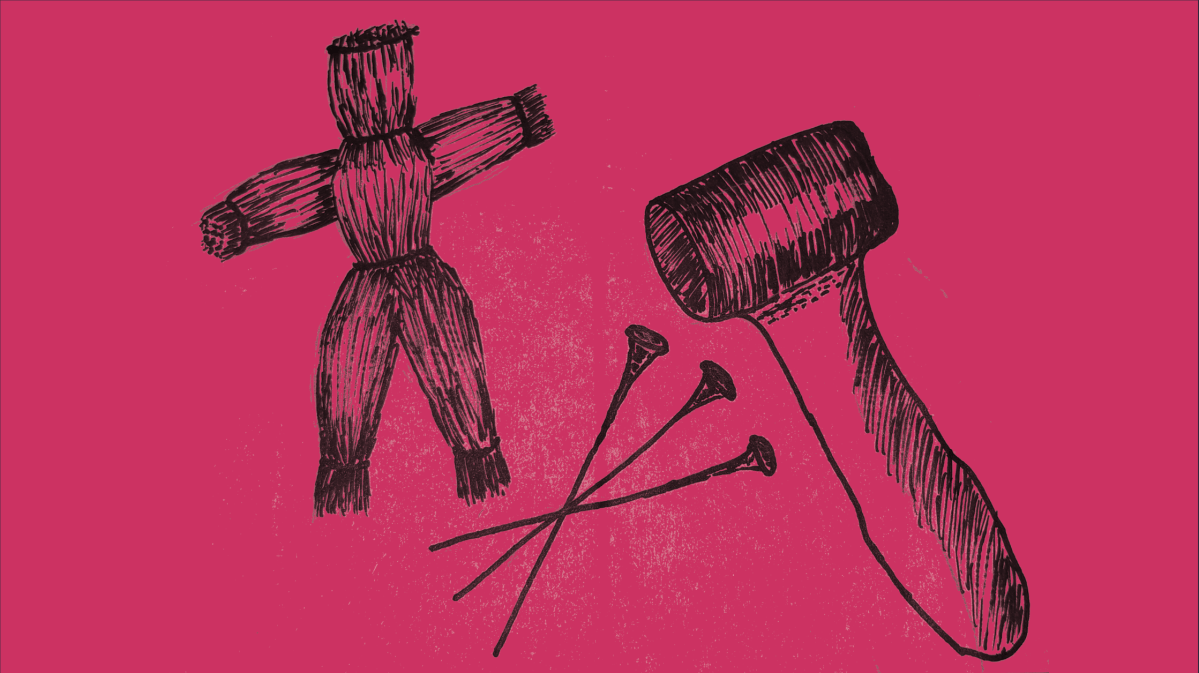
Soon after WWII, a farmer’s housewife in Akita prefecture was cought by a police, after stabbed a gosun-nail (about 6 inches) through a straw figurine with the name of the “other woman” her husband was cheating on, onto a holy tree in a shrine. The prosecutor side claimed that the housewife should be found guilty of attempt of murder for conducting the Ushi-no-koku-mairi ritual with an intent to murder, but the court could not prove the causality of the between the curse and murder. Thus she was only found guilty for intimidation. This was inevitably a moment that the law admit that a person can not be found guilty of murdering via curse.
Ushi no koku mairi (丑の刻参り) is a prescribed method of cursing, traditional to Japan. The name comes from the fact that the ritual is to be practiced during the hours of the Ox (1-3 AM). During the ritual, a straw figurine is pierced/hammered with a nail (often onto a holly tree in a shrine) with specified equipment and outfit. Notably, this ritual is supposed to be conducted with the intent to harm/kill the individual represented in the figurine. However, it is often said that if witnessed during the ritual, the person who is cursing will be inflicted with the curse, often resulting in death. While there are probably countless curing rituals across different corners of our planet, I would say this is one of the most iconic “styles” in Japan when it comes to cursing rituals, and it is heavily referenced and used as a motif in pop culture.
Anyway, back to the anecdote from the drama, watching this time round, I couldn’t help but wonder… is such a court case real? I searched across the internet to see if I could find a credible source on this incident, but there was no hit in the precedence database/newspaper archive of the prefecture. (But strangely enough, a query with a very similar story & question as mine was made to the prefecture’s library through a collaborative reference database in 2022… more on this later.) Therefore, it is probable that this anecdote is more of a fictional case to illustrate the central themes explored in the episode of the drama. However, I also noticed something interesting: there were a number of “similar” stories referenced in various TV shows, blogs, and books, with ever so slight variations, but none were apparently traced to an existing record of precedent available online. This led me to believe that there must be something at the root of all of these stories that caused such a scenario to be continuously referenced, so I kept digging.
Personally, I came to believe that these stories most likely did not stem from an actual court case, but rather a “thought experiment” outlined in an old editorial on law. A Japanese law study published back in 1934 (I’m no law nor old text expert, and it wasn’t an easy read) outlines how, in criminal law, cause and effect are seen as a key to establishing whether a given act is… criminal. It runs through several iterations of scenarios, but specifically uses Ushi no koku mairi as an example of a ritual that usually cannot be seen as a directed cause of death of the victim being cursed (bingo!). It further outlines that, however, it WOULD be considered as a cause of death, for example, if it meets the following conditions: 1) if the person being cursed also believes in the said superstition, 2) found out that they are being cursed, and 3) becomes paranoid in fear of being cursed and results in suicide. It also states, however, that essentially without these conditions being met, one is considered to “perform” such rituals in their own discretion as a freedom of individuals. The author points especially in reference to Declaration of the Rights of Man and of the Citizen (note: this is a time period in Japan where law and society at large was going through “modernization” and hence points to this French ideology as a casestudy-ish), that in their modern law, there is a point to be made for the law to protect the right of such individual to “perform” supersitious acts.
… So I guess in that sense, trashing your pillows in your own room in full rage post break-up and conducting this curse in complete privacy (with no blackmailing and vandalism… more on this later) is criminally not too different?
Impossibility defense and “superstitious crime”
Interestingly, it turned out that Ushi no koku mairi is, in fact, seen as a textbook example of superstitious crime variation of impossibility defense (yes, this is a WHOLE GENRE). What is considered as superstition (needless to say) and law itself do change over time and place. Unfortunately, I’m not an expert in either field of sociology or law, but I understood that in the case of Japanese law, supernatural crime is a subcategory of “impossibility defense” in which crime itself is seen as “impossible” because, well, superstition causing the desired outcome is seen as impossible. There are, however, a few premises that could be met as outlined above for a superstitious ritual to be deemed as a murderous crime, but on top of that, it needs the causality to be fundamentally possible, and this is surprisingly a complicated matter. A classic non-superstitious example (as described in this short lecture), was if an assassin shot what they thought was their target lying in bed, but in actuality, the target was not in the bed (maybe it’s a pile of pillows). Then, there is no way that this shooting killed the target even if this target was later found dead (ie, impossible). I will not go into the details of discriminating legal and factual imposibility (because it’s actually hard to draw the line, apparently), but let’s just explore the idea in itself that superstition is a subcategory of actions that act in premises of impossibility. There are apparently few “theories” on why this is justified (again, apologies for the self-translation).
- Conceptual (/subjective)-danger theory: Superstitious criminals pose no risk objectively speaking.
- Causality negation (/objectivity) theory: A crime cannot be committed because there is no causal relationship (ie, in line with the general notion of impossibility defense)
- Theory of Intent: This theory is used to point out how intent matters behind criminal action, thereby acknowledging murderous intent, for example, in the failed attempt at murder. However, for “superstitious crime”, it is believed that this theory won’t be directly applicable because one is relying on the power of the supernatural to actually realize the crime, on behalf of acting with intent themselves.
And regardless of the debate in law regarding the nuances and interpretation, I find the focus of causality to be almost philosophically scientific, or extremely logical at the very least. Such casualties are exactly what the court cases attempt to mount the evidence to approach the consensus truth. If rituals and acts cannot function as a direct cause of say death (in a consistent, replicable manner), the court will act with the premise that that is not possible in seek of a more possible explanation.
But are curses illegal (at all) if they’re ineffective?
I was quite impressed to see that by 1934, the study implied (and in some parts, clearly reads) that superstition-based rituals do not directly cause outcomes like death – ie, NOT REAL in the eyes of the law. So there’s the answer for you: curses are seen as ineffective. But then, is it legal? There are occasionally cases of Ushi no koku mairi that still make news headlines. This is because even if you’ve not successfully cursed someone to death, you entered a shrine (ie, not your property)? That could be a criminal trespass. And you hammered a straw figure, damaging a tree that doesn’t belong to you? That could be vandalism or property damage. And in fact, the latter was the exact charges a 72-year-old man was caught in 2022 who hammered a straw figure with Putin’s face printout stuck on it, in protest of the Russian invasion of Ukraine. So while you can’t (be charged with) murder with this curse, there are elements of illegal acts. Just to be clear, I therefore do not recommend going hammering down some straw figures, and I’d recommend sticking to the self-pillow fight within the confines of your own room. Nevertheless, “murder via curse” is not a legal defense/prosecution that can be made in the current law in Japan.
However, as I have hinted before, what is and isn’t considered a superstition changes over time and place. In fact, even in Japan, an earlier rendition of “modern law” in 1870 seemed to have stated that the cursing rituals could be prosecuted. This to me suggests, at least this time, it was reconginzed a more of a… canon threat? If the whole argument in the 1934- is that curse ritual itself is non-illegal because it’s fake, then being illegal suggests it’s… not fake? As I explored the place of superstition in law more widely, I found this handy Wikipedia page that outlines the state of laws against “witchcraft” (which I’m sure curses can be at least part of… right?), across history and countries. Interestingly, this trend of “repelling” the criminal prosecution of witchcraft (ie, was once illegal but now not) also exists in other countries, including Canada (in 2018) and the UK (1951)! On the other extreme, we have several countries that currently prohibit witchcraft and magic altogether as illegal, or conducting witchcraft against a person is illegal. There are also places where a certain subset of magic/practice (ie, black magic or fortunetelling) is specifically illegal. Then, there are places where pretending to be a witch or accusing someone as a witch is illegal. What I find fascinating is that, in fact, a lot of these laws against witchcraft, magic, and fortunetelling were followed a surprisingly (at least to me) non-linear history within the region and full of diversity. In some instances, it appears (anyway) that prohibitory law was put in place in an attempt to extinguish a malpractice that can be exploitative (in the UK, for example, it was initially covered in Fraudulent Mediums Act 1951 but eventually merged into a subset of Consumer Protection Regulations). However, in other instances, it may be possibly derived from fear from the authorities or desire to control (case and point: the Nazi outlawed fortunetelling in 1934, apparently). So, I don’t have a neat one-size-fits-all conclusion here, but it was interesting to realize how the state of law against witchcraft can deeply reflect the history and the current relationship of superstition and the local society.
Why do curses still persist?
Naturally, being a CUSAP member (and just to remind you, pseudoscience is arguably just a sciency superstition), I don’t think you can curse people to death because of fairy power or deviations. But I can appreciate that it could (and still in some cases) hold a strong presence in society, and in that sense it is very real to a point where it is even discussed as an example scenario in laws. And personally, I don’t think this is just an artifact of historical beliefs pre-dating scientific methods or modern procedures of law. I (unfortunately?) think curses, magic, and witchcraft persist because there is (and possibly always will be) a demand.
Of course, some people might curse because they are… well, mean. The classical evil witch. The Grinch type wishes the worst for everyone. But let’s go back to the initial anecdotal case of the farmer’s housewife. Something I didn’t mention is that Ushi no koku mairi is somewhat associated with women, not so much because there’s anything feminine about hammering a nail, but a typical reason behind it, like lovers’ betrayal and jealousy, was often not met with justice. Particularly in recent Japanese history, a wife committing adultery in itself was punishable by crime (until 1947 when it was revoked due to gender inequality), while it was often not the same for men. When you faced a betrayal, but there’s no place in law where you will be compensated or meet justice, won’t justice by supernatural means seem all of a sudden alluring? Somewhat unintuitively, with the access to the internet, some say the witchcraft service and market is bigger than ever (I’ll go down this rabbit hole some other day), and unfortunately, it seems to be filled with “wishes” from people who had their hearts broken and were one way or another, hurt. I’ve also seen online threads recommending different curse methods, and they’re often filled with comments of pain, grudge, arising from things like bullying.
Again, I’m not saying grabbing a hammer or drawing summing circles in the next instances of someone cheating on you is a good idea, but I can also see how this can perhaps help people release their steam in a relatively safe way, perhaps in part because it’s most likely not going to do anything. To me, the bigger concern is how this emotion of vengeance might consume someone (mental well-being-wise), and it also can make someone ripe for exploitation (ie, how do you know that one-time purchase of curse survival of fortunetelling will not snowball to spending a fortune to purchase magical devices and expensive charms?). Ultimately, the answer to the world that CUSAP envisions and a world without curses may have quite a bit in common: it’s a world of compassion and open dialogue, which is fundamental to justice based on truths. Realistically, this is not an easy feat, so magic and curses might persist or even prevail, especially in this ever-online world where injustice and disparity seem to be increasing. So next time you see a broken heart or someone being a bit too serious with their fortunetelling reads, remember the position curses in the eyes of the law, and take them out for a coffee. Who knows, maybe that will be the perfect (legal) white magic to make their day better 🙂
 Students Against Pseudoscience