
Can we buy clean air?

Air Pollution in Mumbai, photo taken by Kartik Chandramouli

Author: Arjun Kamdar

Over the last few weeks the air pollution levels in India have reached extremely hazardous levels. On several days, seventy-four of the hundred most air polluted cities were in India. This is a serious crisis that is impacting everything that breathes, and is rightly being considered a public health emergency. Among the many marketed solutions, one caught my attention and is deeply alarming: wearable air purifiers.

Searching for solutions

Understandably, this crisis has people scrounging for solutions. The idea of a small, high-tech device that one can carry around and promises to purify the air has intuitive appeal. This little device costs about £30, it comes via a glossy website, uses the word ‘scientific’ in copious amounts, and has pastel colour options. All that seems to be missing is a man in a lab coat smilingly recommending this as the ultimate solution. Fundamentally, this sells the idea that air can be privatised – this little rock around one’s neck can create a portable halo and emits negatively-charged anions that ‘attack’ the bad particles to ‘purify’ the air. There is one major problem; it does not work. 

Air as a public bad

For decades, India’s urban elite have shielded themselves from the failures of public systems. Healthcare, education, security, transport – most of these have been informally privatised. Those who can afford it buy their way out of poor public infrastructure.  

Air, however, is different. It is defined as a public good, or in this case, a public bad. This means that it is (1) non-excludable (no one can be prevented from breathing it) and non-rivalrous (one person’s use does not reduce availability for another). The textbook example of a public good is, ironically, a fireworks show: no one can be excluded from enjoying it, and one person’s enjoyment does not diminish the experience for anyone else. The same logic applies to air: we all share the same air, and it is impossible to contain it in one place or prevent someone from breathing it. There are no neat delineations between indoor and outdoor air.
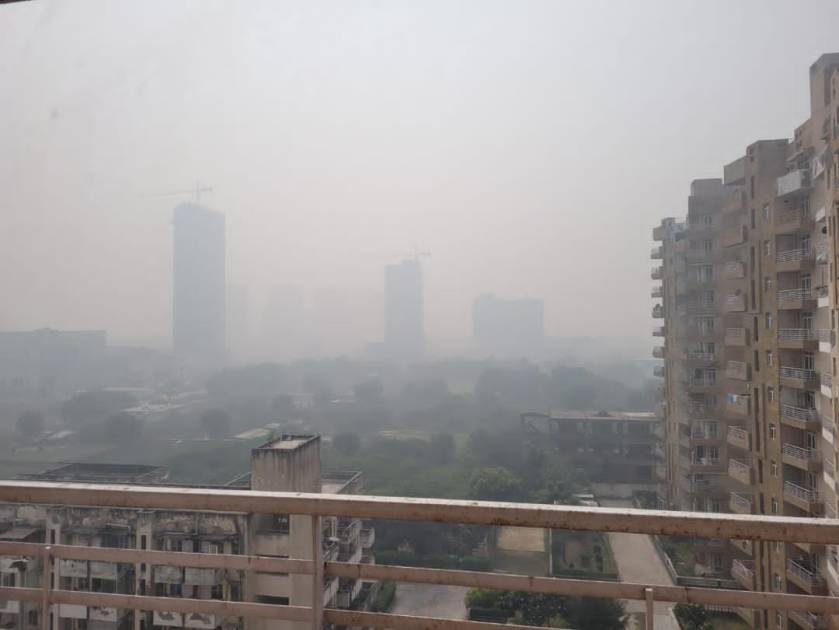
Smog blankets buildings in Gurugram. Photo by Niranjan B.

The pseudoscience of wearable air purifiers

This is why air pollution demands collective action. No technological innovation can bypass this. While using masks or creating ‘clean air bubbles’ by installing indoor filtration systems or based on robust technology like HEPA filters can help to some extent, eventually, one must step outside or open a window. Wearable devices are marketed as the silver-bullet solution, despite there being no real evidence for their efficacy – neither in practice nor for what they market as “Advanced Variable Anion Technology”.

The scientific claims behind many of these products crumble when looked at closely. Companies cite ‘certifications’ and ‘lab tests’ from prestigious institutions like the Indian Institute of Technology (IIT), one of India’s top engineering and science universities, a well-chosen appeal for the target audience of India’s urban elite and upper-middle class. However, the referenced tests have a fundamentally flawed study design, with too few repetitions to carry any scientific weight/value. In some of these tests they burn an incense stick in a sealed chamber suggested to be representative of air pollution outdoors in India, and then measure the reductions in ultrafine particulate matter over time, without any control condition. Such designs fail at both internal validity, i.e., the mechanism of action as well as external validity, since they ignore the complexity of outdoor pollution, which depends on wind, humidity, temperature inversions, particle composition, emission sources, and dozens of other factors. And most importantly, a seemingly endless supply of pollution. These wearable devices may as well be a bunch of flashing lights.

Some of these devices verge on the dystopian. One widely advertised model resembles a potted plant with plastic leaves, claiming that this technology will purify the surrounding air. The irony is stark. Some also offer these devices for corporate gifting. 

Implications of misinformation

If these devices genuinely worked, or even showed promise, they would already be the focus of research and public health practice. Air pollution is not a novel challenge for humanity, and neither is the knowledge of ions. We understand these technologies well, and the reason they have not advanced further is simple:  because science has already shown that this is a dead end.

There are two critical implications of this misinformation. One, it is unethical and exploitative, and two, it can crowd out motivations for the systemic change that is needed to tackle this large challenge.

These devices exploit people’s vulnerabilities – the legitimate fears that people have for themselves and their loved ones is used to turn a quick buck. Selling untested gadgets during a public health crisis is a dangerous manipulation of public fear for personal gain. The burden of proof of the efficacy of these devices lies with manufacturers, it is not the job of citizens or scientists to test and gather evidence that they don’t work. This is understood in section 2(47) and 18-22 of the Consumer Protection Act, 2019 on ‘unfair trade practices’ and the penalties for misleading advertisements.

Customers of these products I spoke with mentioned that while they are sceptical, “it might at least do something, if not as much as these companies promise”. While the sentiment is understandable, this is a very dangerous narrative. A proliferation of this flawed idea that clean air can be acquired through a quick, personal fix, could weaken the pressure on the government to take action and enact the systemic reforms that are needed. This crowding out of motivations is a real threat to movements that require long-term action. Air pollution is a public and collective challenge, impacting everyone from all classes and therefore, could be a catalysing factor for demanding structural changes. The misconception that private, individual-specific solution is a possibility hinders this, leading to a continuation of the status quo.

A member of parliament wore such a device by a company called Atovio a few months ago – this explicit validation by a public figure, even unknowingly, only amplifies misinformation and gives these dishonest claims a misleading legitimacy.

Air pollution shrouds the streets of Mumbai. Photo by Shaunak Modi.

Can air pollution be solved?

It is not an intractable problem; Beijing faced similar challenges in 2013 as did Bogota in 2018. Both cities ramped up their efforts and managed to tackle the seemingly insurmountable challenge of air pollution through the evidence-backed combination of strict emission controls and regulatory enforcement, and transformative shifts in urban mobility and energy use. India can too. 

This potential is evident to India’s citizens; people from all walks of life and classes have mobilised,  organising protests and legal arguments across the country to confront this serious threat.

There is no technology yet that can privatise air. Structural changes in how cities and societies function are the only real solution, and until then air will remain a public bad. Some problems cannot be bought away.
Legality of curses and the “impossible crime”

Author: Maya Lopez (Co-President)

Now that we’re back for another academic year in full swing, summer feels distant. I was back in my home country (Japan) during the break, which was a time for me to indulge in countless horror features and reruns, even before the spooky month of October. This might seem strange, but traditionally in Japan, the season most associated with “horror” as a genre is arguably the summer, probably due to seasonal events like Obon – a custom of paying a visit to familial graves to honor ancestors/recently deceased, rooted in a belief that ancestral spirit returns to the world of living. And of course, the traditional performance arts that cover the topic of ghosts and horror cement this notion. However, not all horror stories necessarily invoke the spook via ghosts, but rather, curses and grudges by the living. This brought me straight down the rabbit hole of curses – what many (of us probably) deem as superstition, its unexpected verdict in the eyes of law, and a further surprisingly complicated view into what law perceives as possible and impossible. Spoiler alert: the world of law seems to already have given an answer to whether (at least some of) the occult practices are considered real or unreal (at least in some countries). Thus, here’s the “horror edition (?)” from CUSAP, and join me for the crazy ride of curses and the impossible crime.

Can there be a murder via a curse?

There’s a story I saw as an anecdotal opening in one of my favorite Jdrama reruns, and it goes something like this (apologies for the self-translation):

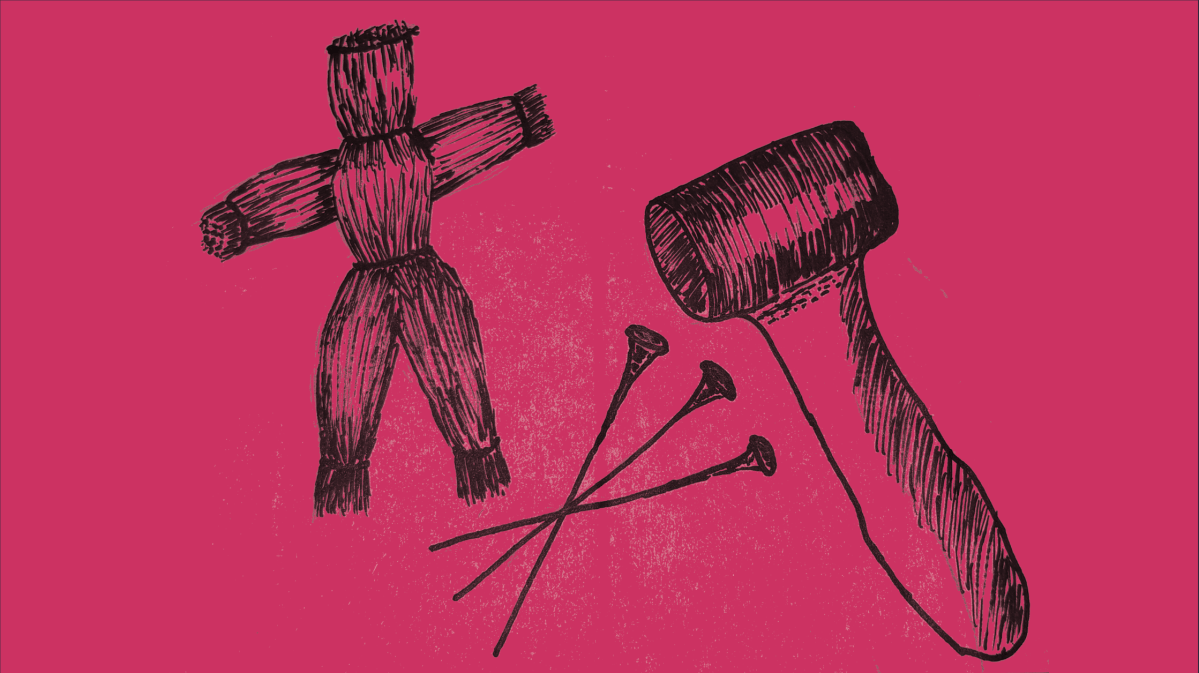
Soon after WWII, a farmer’s housewife in Akita prefecture was cought by a police, after stabbed a gosun-nail (about 6 inches) through a straw figurine with the name of the “other woman” her husband was cheating on, onto a holy tree in a shrine. The prosecutor side claimed that the housewife should be found guilty of attempt of murder for conducting the Ushi-no-koku-mairi ritual with an intent to murder, but the court could not prove the causality of the between the curse and murder. Thus she was only found guilty for intimidation. This was inevitably a moment that the law admit that a person can not be found guilty of murdering via curse.

Ushi no koku mairi (丑の刻参り) is a prescribed method of cursing, traditional to Japan. The name comes from the fact that the ritual is to be practiced during the hours of the Ox (1-3 AM). During the ritual, a straw figurine is pierced/hammered with a nail (often onto a holly tree in a shrine) with specified equipment and outfit. Notably, this ritual is supposed to be conducted with the intent to harm/kill the individual represented in the figurine. However, it is often said that if witnessed during the ritual, the person who is cursing will be inflicted with the curse, often resulting in death. While there are probably countless curing rituals across different corners of our planet, I would say this is one of the most iconic “styles” in Japan when it comes to cursing rituals, and it is heavily referenced and used as a motif in pop culture.

Anyway, back to the anecdote from the drama, watching this time round, I couldn’t help but wonder… is such a court case real? I searched across the internet to see if I could find a credible source on this incident, but there was no hit in the precedence database/newspaper archive of the prefecture. (But strangely enough, a query with a very similar story & question as mine was made to the prefecture’s library through a collaborative reference database in 2022… more on this later.) Therefore, it is probable that this anecdote is more of a fictional case to illustrate the central themes explored in the episode of the drama. However, I also noticed something interesting: there were a number of “similar” stories referenced in various TV shows, blogs, and books, with ever so slight variations, but none were apparently traced to an existing record of precedent available online. This led me to believe that there must be something at the root of all of these stories that caused such a scenario to be continuously referenced, so I kept digging.

Personally, I came to believe that these stories most likely did not stem from an actual court case, but rather a “thought experiment” outlined in an old editorial on law. A Japanese law study published back in 1934 (I’m no law nor old text expert, and it wasn’t an easy read) outlines how, in criminal law, cause and effect are seen as a key to establishing whether a given act is… criminal. It runs through several iterations of scenarios, but specifically uses Ushi no koku mairi as an example of a ritual that usually cannot be seen as a directed cause of death of the victim being cursed (bingo!). It further outlines that, however, it WOULD be considered as a cause of death, for example, if it meets the following conditions: 1) if the person being cursed also believes in the said superstition, 2) found out that they are being cursed, and 3) becomes paranoid in fear of being cursed and results in suicide. It also states, however, that essentially without these conditions being met, one is considered to “perform” such rituals in their own discretion as a freedom of individuals. The author points especially in reference to Declaration of the Rights of Man and of the Citizen (note: this is a time period in Japan where law and society at large was going through “modernization” and hence points to this French ideology as a casestudy-ish), that in their modern law, there is a point to be made for the law to protect the right of such individual to “perform” supersitious acts.

… So I guess in that sense, trashing your pillows in your own room in full rage post break-up and conducting this curse in complete privacy (with no blackmailing and vandalism… more on this later) is criminally not too different?

Impossibility defense and “superstitious crime”

Interestingly, it turned out that Ushi no koku mairi is, in fact, seen as a textbook example of superstitious crime variation of impossibility defense (yes, this is a WHOLE GENRE). What is considered as superstition (needless to say) and law itself do change over time and place. Unfortunately, I’m not an expert in either field of sociology or law, but I understood that in the case of Japanese law, supernatural crime is a subcategory of “impossibility defense” in which crime itself is seen as “impossible” because, well, superstition causing the desired outcome is seen as impossible. There are, however, a few premises that could be met as outlined above for a superstitious ritual to be deemed as a murderous crime, but on top of that, it needs the causality to be fundamentally possible, and this is surprisingly a complicated matter. A classic non-superstitious example (as described in this short lecture), was if an assassin shot what they thought was their target lying in bed, but in actuality, the target was not in the bed (maybe it’s a pile of pillows). Then, there is no way that this shooting killed the target even if this target was later found dead (ie, impossible). I will not go into the details of discriminating legal and factual imposibility (because it’s actually hard to draw the line, apparently), but let’s just explore the idea in itself that superstition is a subcategory of actions that act in premises of impossibility. There are apparently few “theories” on why this is justified (again, apologies for the self-translation).

  1. Conceptual (/subjective)-danger theory: Superstitious criminals pose no risk objectively speaking.
  2. Causality negation (/objectivity) theory: A crime cannot be committed because there is no causal relationship (ie, in line with the general notion of impossibility defense)
  3. Theory of Intent: This theory is used to point out how intent matters behind criminal action, thereby acknowledging murderous intent, for example, in the failed attempt at murder. However, for “superstitious crime”, it is believed that this theory won’t be directly applicable because one is relying on the power of the supernatural to actually realize the crime, on behalf of acting with intent themselves.

And regardless of the debate in law regarding the nuances and interpretation, I find the focus of causality to be almost philosophically scientific, or extremely logical at the very least. Such casualties are exactly what the court cases attempt to mount the evidence to approach the consensus truth. If rituals and acts cannot function as a direct cause of say death (in a consistent, replicable manner), the court will act with the premise that that is not possible in seek of a more possible explanation.

But are curses illegal (at all) if they’re ineffective?

I was quite impressed to see that by 1934, the study implied (and in some parts, clearly reads) that superstition-based rituals do not directly cause outcomes like death – ie, NOT REAL in the eyes of the law. So there’s the answer for you: curses are seen as ineffective. But then, is it legal? There are occasionally cases of Ushi no koku mairi that still make news headlines. This is because even if you’ve not successfully cursed someone to death, you entered a shrine (ie, not your property)? That could be a criminal trespass. And you hammered a straw figure, damaging a tree that doesn’t belong to you? That could be vandalism or property damage. And in fact, the latter was the exact charges a 72-year-old man was caught in 2022 who hammered a straw figure with Putin’s face printout stuck on it, in protest of the Russian invasion of Ukraine. So while you can’t (be charged with) murder with this curse, there are elements of illegal acts. Just to be clear, I therefore do not recommend going hammering down some straw figures, and I’d recommend sticking to the self-pillow fight within the confines of your own room. Nevertheless, “murder via curse” is not a legal defense/prosecution that can be made in the current law in Japan.

However, as I have hinted before, what is and isn’t considered a superstition changes over time and place. In fact, even in Japan, an earlier rendition of “modern law” in 1870 seemed to have stated that the cursing rituals could be prosecuted. This to me suggests, at least this time, it was reconginzed a more of a… canon threat? If the whole argument in the 1934- is that curse ritual itself is non-illegal because it’s fake, then being illegal suggests it’s… not fake? As I explored the place of superstition in law more widely, I found this handy Wikipedia page that outlines the state of laws against “witchcraft” (which I’m sure curses can be at least part of… right?), across history and countries. Interestingly, this trend of “repelling” the criminal prosecution of witchcraft (ie, was once illegal but now not) also exists in other countries, including Canada (in 2018) and the UK (1951)! On the other extreme, we have several countries that currently prohibit witchcraft and magic altogether as illegal, or conducting witchcraft against a person is illegal. There are also places where a certain subset of magic/practice (ie, black magic or fortunetelling) is specifically illegal. Then, there are places where pretending to be a witch or accusing someone as a witch is illegal. What I find fascinating is that, in fact, a lot of these laws against witchcraft, magic, and fortunetelling were followed a surprisingly (at least to me) non-linear history within the region and full of diversity. In some instances, it appears (anyway) that prohibitory law was put in place in an attempt to extinguish a malpractice that can be exploitative (in the UK, for example, it was initially covered in Fraudulent Mediums Act 1951 but eventually merged into a subset of Consumer Protection Regulations). However, in other instances, it may be possibly derived from fear from the authorities or desire to control (case and point: the Nazi outlawed fortunetelling in 1934, apparently). So, I don’t have a neat one-size-fits-all conclusion here, but it was interesting to realize how the state of law against witchcraft can deeply reflect the history and the current relationship of superstition and the local society.

Why do curses still persist?

Naturally, being a CUSAP member (and just to remind you, pseudoscience is arguably just a sciency superstition), I don’t think you can curse people to death because of fairy power or deviations. But I can appreciate that it could (and still in some cases) hold a strong presence in society, and in that sense it is very real to a point where it is even discussed as an example scenario in laws. And personally, I don’t think this is just an artifact of historical beliefs pre-dating scientific methods or modern procedures of law. I (unfortunately?) think curses, magic, and witchcraft persist because there is (and possibly always will be) a demand.

Of course, some people might curse because they are… well, mean. The classical evil witch. The Grinch type wishes the worst for everyone. But let’s go back to the initial anecdotal case of the farmer’s housewife. Something I didn’t mention is that Ushi no koku mairi is somewhat associated with women, not so much because there’s anything feminine about hammering a nail, but a typical reason behind it, like lovers’ betrayal and jealousy, was often not met with justice. Particularly in recent Japanese history, a wife committing adultery in itself was punishable by crime (until 1947 when it was revoked due to gender inequality), while it was often not the same for men. When you faced a betrayal, but there’s no place in law where you will be compensated or meet justice, won’t justice by supernatural means seem all of a sudden alluring? Somewhat unintuitively, with the access to the internet, some say the witchcraft service and market is bigger than ever (I’ll go down this rabbit hole some other day), and unfortunately, it seems to be filled with “wishes” from people who had their hearts broken and were one way or another, hurt. I’ve also seen online threads recommending different curse methods, and they’re often filled with comments of pain, grudge, arising from things like bullying.

Again, I’m not saying grabbing a hammer or drawing summing circles in the next instances of someone cheating on you is a good idea, but I can also see how this can perhaps help people release their steam in a relatively safe way, perhaps in part because it’s most likely not going to do anything. To me, the bigger concern is how this emotion of vengeance might consume someone (mental well-being-wise), and it also can make someone ripe for exploitation (ie, how do you know that one-time purchase of curse survival of fortunetelling will not snowball to spending a fortune to purchase magical devices and expensive charms?). Ultimately, the answer to the world that CUSAP envisions and a world without curses may have quite a bit in common: it’s a world of compassion and open dialogue, which is fundamental to justice based on truths. Realistically, this is not an easy feat, so magic and curses might persist or even prevail, especially in this ever-online world where injustice and disparity seem to be increasing. So next time you see a broken heart or someone being a bit too serious with their fortunetelling reads, remember the position curses in the eyes of the law, and take them out for a coffee. Who knows, maybe that will be the perfect (legal) white magic to make their day better 🙂

Science and extreme agendas

Author: Raf Kliber (Social Media Officer)

Original feature image art specially drawn by: TallCreepyGuy

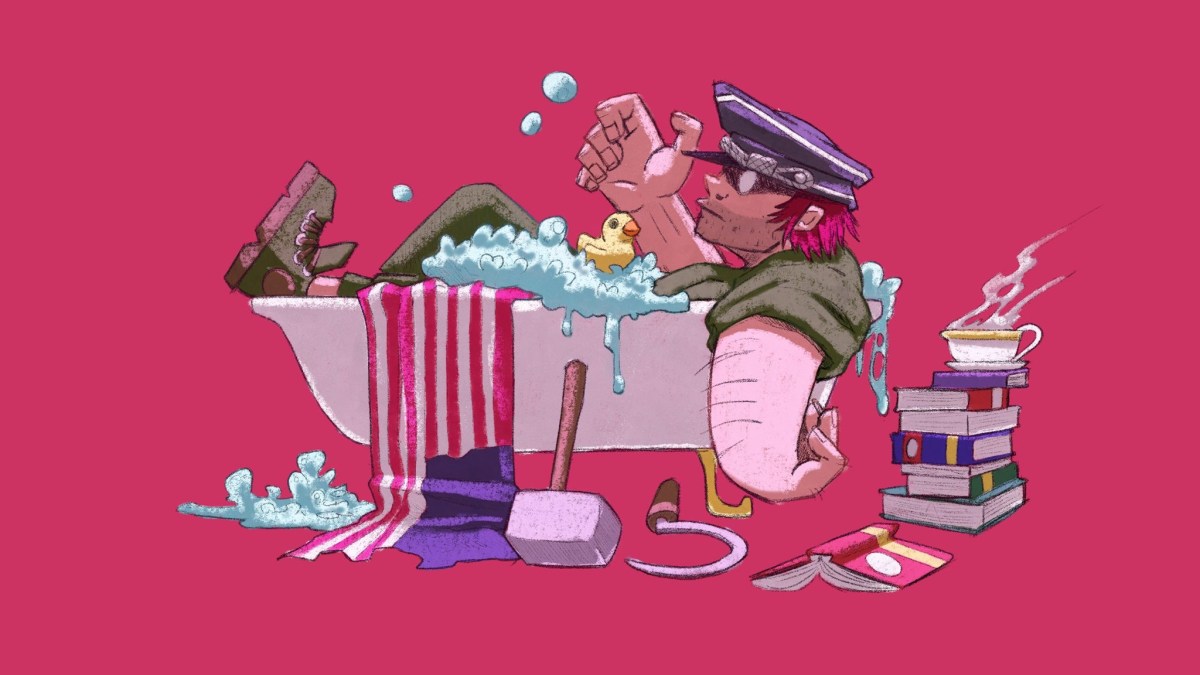
While I work myself to boredom at a local retail store, I listen to some podcasts in the background. Something to cheer me up. Among my favourites are the Nature Podcast and Climate Denier’s Playbook. But, on that specific Wednesday, the episode was anything but cheering. I landed on the Nature Podcast’s “Trump team removes senior NIH chiefs in shock move” episode, which provided me with a bleak look into the current US administration’s proceedings. The bit that shocked me the most was how much the move clung to Project 2025‘s agenda. One of the moves discussed was a defunding of ‘gender ideology’ driven research (read anything that includes the word trans, even though such research is useful for everyone). Furthermore, instead of such ‘unimportant’ research, the administration wanted to conduct studies into ‘child mutilation’ (read trans conversation therapy) at hospitals. Eight hours later, while soaking in a mandatory afterwork bath, I began pondering “what is the interplay between extreme agendas and the ‘fall’ of science?” and “what I, a STEM person, could do about it?”. As a Polish person, my first bubbles of ideas started with fascism and the Third Reich.

Jews, fascism, and ‘directed’ science

I moved to the UK when I was twelve years old. This event spared me the traditional trip to Auschwitz one takes when in high school. It spared me from the walls scratched by the nails of the people trapped in gas chambers. It spared me from the place so horrible yet so pristinely preserved that visiting it is as close to time travel as one can get. About a fifth of the population of Poland was wiped out in World War II. On average, every family lost someone. Not on average, many families were completely gone. Due to the gravity of the topic at hand I reached out to Dr. Martin A. Ruehl, lecturer in German Intellectual History at the Faculty of Modern and Medieval Languages at University of Cambridge for some guidance. He also gave a talk on “What is fascism?” during the Cambridge festival, which I recommend. Another reason is that I am by education, a physicist, and just as physicists have their own set or rigorous habits that make their field solid, historians and philosophers have theirs.

Fascism as an idea is fuzzy, or at least with fuzzy borders. One knows definitely that after Hitler took over the power in Germany, it took on Fascist ideology. It is also abundantly clear that the current UK is not a fascist regime. Trying to nail the border delineating the least fascistic and just about not fascistic regime is futile, complicated further by each regime having their own unique element. The process of how it festers and develops in a country is left for others to explain, and I encourage the reader to watch this video essay by Tom Nicholas on how to spot a (potential) fascist. I will go with the conclusion of Dr Ruehl’s talk. Fascism is a racist, nationalistic, extreme and violent idea that often puts the core group in a self-imposed theoretical attack from the outgroup. (e.g. Jews were an imagined threat to the German state, even though they weren’t). I procrastinate talking about subject matter to highlight two important points: Fascism is a complex topic that could be studied for lifetimes and consequently, I am not an expert. I have made my best attempt at giving it the due diligence it deserves.

Disclaimers aside, what was the state of science during Hitler’s reign? Let us set the scene. The role I’d like us to play is that of a scientist at the time. Let us imagine ourselves in 1933 Germany, right at the beginning of the Nazi reign. Nazi party made it rather clear: Either you, as the scientist, are ready to conduct research that aligns with the party’s agenda, or you’re out of academia. Unless you’re Jewish and known to be on the left of the political spectrum (historical pre-nazi left, although it would still include things like early transgender care, for example, as advocated by Magnus Hirschfeld), then you don’t get a choice. Physics Today has a nice article that contains the migration of selected physicists out of Nazi Germany, which I recommend having a look at. Similar goes for other branches of science. The crux of the situation is that if you are studying races or ballistics, you are more than welcome to stay. Hitler did recognise that only the most modern military equipment would allow for the Third Reich to wage war on everyone. Similarly, he did want to put his ideals onto the firm foundation of “cold and logical” science, even though at times that compromised the scientific process. For example, the creation of Deutsche Physik (which denied relativity) and the burning of books by the above-mentioned Magnus Hirschfeld. (As much as my past self would thoroughly disagree, trans people are a cold and logical conclusion of how messy biology can be. More so than arbitrarily dividing all of population into two buckets.)

The adoption of the idea of Social Darwinism (that fittest social groups survive) and the knowledge of what genes do (albeit well before the discovery of DNA structure and the ability to compare genomes) created the foundation of ignorance for ‘scientific racism’ and eugenics. That being said, there was more to it than the current state of not-knowing. According to the introduction of “Nazi Germany and the Humanities” edited by Wolfgang Bialas and Anson Rabinbach, “Creation of the hated Weimar Republic created a deep sense of malaise and resentment among the mandarins, who, for all their differences, had in common the belief that a “profound ‘crisis of culture’ was at hand””. To draw a conclusion, the loss of the war and a tense national atmosphere led to the development of such völkisch ideals way before Hitler’s regime touched the ground. To further quote, “many retained the illusion of intellectual independence”. The general sense of superiority also gave rise to books like Deutsche Physik, a work that opposed Albert Einstein’s work directly.

(Note from the author: Googling “Social Darwinism” will lead you to creationist videos by Discovery Science (A YouTube channel by Discovery Institute, a fundamental creationist think tank). They seem to be hooked on using the aforementioned atrocities to try to link Darwin, and his early understanding of evolution, to Satan and hence to him leading us away from God with his theory. It is worth mentioning that although it bears his name, Darwin did not play a role in coining or using the term.)

To summarise this section: The way the corrupt ideals spread into science and politics in Nazi Germany arose from discontent and false hope. It was more of a fork situation. Both the world of academia and politics took up the story of national threat and superiority due to high levels of discontent originating from the Weimar era, and while intertwined together, I think that the cross-influence only amplified the process. This resulted in academia and politics taking up both ideals independently, and simply supported each other in the downward spiral such as antisemitism.

USSR, Russia, and limiting scientific cooperation.

A nice cup of tea on the following day led to some more thinking about other regimes. Like a true ‘Brit’, I took out my teapot and with a cup of Earl Gray in a fancy Whittard porcelain in my hand, I drifted off again into another rabbit hole. This time instead of west, I dug the tunnel east.
An interesting tidbit from my past regards my primary school. The changing rooms in that place had an interesting design. If one were to pay enough attention, they would see a system of grooves in the floors that were meant to act as drainage. Why drain something from an indoor location? The changing room was meant to serve as an emergency field hospital in case of another war. The school turns out to be old enough to see some of the old soviet practices in its design. For those unaware, Poland was part of the Soviet bloc up until 1991. Just 12 years before my birth, and 13 before Poland joined the EU. So let us journey to the east and see what history has to teach us.

Stalin was a dictator, just like his Austrian-German counterpart. What is slightly different is the ideology that shaped the persecution of scientists at the time –  a different flavour of extremism. I could go on a rant about what Stalinist flavour of Marxism is, but just like Fascism, there are scholars who spend their lives studying it. I am not one of them.

Nevertheless, the parallels between the corruption of sciences in Fascist Germany and Stalinist USSR are rather staggering for such different ideologies. In Germany, anything considered Jewish or going against the greatness of the Aryan race was immediately cut out, while the rest was bent towards the leading political party’s view. Here it was much the same. The humanist subjects took the largest hit in independence, as those in Germany. Lysenkoism played a role in slowing down the genetics research in the USSR. Instead, what followed was an increase in Lamarckism (acquired characteristics are passed on, rather than typical natural selection). This then, possibly, contributed to agricultural decline, creating another subject of memes for the edgy GenZ.

This also led further to isolation of the scientists. While every now and then they would invite foreign scientists (as Feynman wrote in his letters, and let us be honest, this might have been because of his involvement in Los Alamos) the mingling of Russian scientists with the rest of the world was minimal. Did I forget to mention that geneticists were often executed for not agreeing with Lysenkoism? Science is a global endeavour for a reason. It needs way more manpower than any country alone has. A country can never be a fully independent branch, it will simply lead to a slow withering of progress.

To have a nice circular structure in this section and bring it back to my home: Attitudes can also persist after occupation. The Polish government made some unpopular moves in academia during the time of the PIS party. Polish academia uses a scoring system, where each publication in a journal grants you points. Each point tries to quantify your contribution to a field. So technically a biochemistry paper would give you points in both biology and chemistry. They started awarding more points for papers in Polish journals rather than international ones, alongside some mixing of awarding points in political sciences for publishing theology papers. This may be seen as a slight resurrection of the national pride in sciences which I despise so much (Springer Nature’s journals are always going to be my favourite to skim through).

So what?

My Eurocentric summary of history is probably boring you to death. Let us talk about the US. Trump! The name that makes my hair stand on the back of my neck. The similarity of what is currently happening in the USA really makes me think that history does indeed repeat itself.

Firstly, just like Lysenko and his anti-genetics, Trump decided to elect RFK Jr as the minister of HHS. A well known opponent of vaccines is in a position of hiring and firing researchers. The MAHA (make America healthy again) report included a lot of less-than-optimal healthcare research directions. RFK really believes in a mix of the terrain theory (that the terrain of your body i.e. fitness and nutrition, play THE most important part of your immune system) and miasma theory (covered in a previous article here, but basically a medieval theory on bad air making you sick). There are a whole host of reasons for a person to also point out that a recovering drug addict and brain tapeworm survivor does not make for a great leader for a health agency. To be a devil’s advocate though, he did come up as an environmental lawyer. Additionally, RFK supports removal of fluoride from water and has helped to spread misinformation about vaccines in Africa. He has a very tangible body count and actively harms populations.

Secondly, there are the topics from the headlines in the first section. It is clear that the current administration’s aims are not simply doing science to explore x, but rather confirming x under the guise of science. This is why 75% of scientists that answered Nature’s poll said that they are looking to move out of the USA. Additionally, in a piece by the New York Times, experts in Fascism are also moving away from USA. It is something that is now consequently causing the ‘brain drain’ in the USA and, ironically for an administration that is anti-China, hands over the scientific majority to China. (Whether you think that is good or bad, is up to you. I personally am neutral.) Additionally, the administration has already tried to block Harvard’s ability to admit international students which contribute heavily towards their income stream – all in retaliation for Harvard allowing students to express their right to free speech and protest in favour of Palestine. This is slightly more sneaky than executions and imprisonments. Nevertheless, in a capitalist society, it might be somewhat equivalent when the funding we all depend on goes dry.

Lastly, there is a difference I would like to point out. Regimes like the one above often arose from a dire need for a radical leader and major changes. The current administration is exercising what I would like to call stealth authoritarianism (as coined by Spectacles here). Gone are the days of having posters with long-nosed depictions of minorities that eat children on every street (although the ‘they eat the dogs’ moment was close enough for many). The current US president is using rather specialised and closed off social media to reserve their opinions to their most dedicated followers rather than the general public. We live in the age where the algorithm separates us. It is becoming ever less likely to encounter an opinion we disagree with out in the wild without searching for it. Executions are no longer needed to silence the critics, for as long as you have a devoted fanbase, the infectiousness of the internet can create a potent and numerous enough group to win the election.

The fact that someone can be so overtly against reality, so blatantly corrupt, yet at the same time can feed a mirage to the right people to get elected is the true curse of the modern information landscape. For me personally, it is the main reason why CUSAP and similar societies are more important now than ever before.

What can you do

Every good opinion piece should end with a call to action. I also don’t want this entire blog post to be a long way of saying “AAAA WE ARE ALL GOING TO DIE!!!”, because we most likely won’t.

  • If you are in the USA and courageous enough, protest. It should be easy enough to find one nearby. This is not the main recommendation. Police brutality has already made itself visible in the past month.
  • What you can do more safely is support local lobbying. Be prepared that democracy is not as accessible as it seems. Genetically modified skeptic has posted their experiences trying to vote down the requirement for schools in Texas to have the 10 Commandments in classrooms. It was not a pleasant experience, but organisation and support for lobbying individuals can go a long way. Even if it means bringing them food and supplies or sitting in to notify them when it is their turn to speak at meetings.
  • Vaccinate your family against misinformation. The emotions can run high when politics are involved, but perhaps you can connect one bit of their viewpoint to that kernel of truth that may help. My personal jab at right-wing oil enthusiasts is to connect it with their dislike of migration, as this is a likely result of climate change. (Yes, I don’t believe migration is bad, but they do. Sometimes, you have to engage one topic at a time.)
  • Join a group to lobby and promote critical thinking. Here at CUSAP we try to go beyond Cambridge; thus we welcome articles written by non-members. You can get in touch with us at the https://cusap.org/action/. Youth against misinformation is another one. Plenty more can be found online.
  • Most importantly, do not shut up. Speak up when you see fake news. Don’t get distracted by trivial problems. Call your local political governors, meet with them, email them. This goes regardless of which party they are associated with. Make sure that they know that the truth is what you support. (It goes without saying, as long as you feel safe to do so)
  • Lastly, for my own sanity: do not be nihilistic about how little significance one action or vote has. One vote can make a lot of difference when it is surrounded by a couple thousand more singular votes.