
Can we buy clean air?

Air Pollution in Mumbai, photo taken by Kartik Chandramouli

Author: Arjun Kamdar

Over the last few weeks the air pollution levels in India have reached extremely hazardous levels. On several days, seventy-four of the hundred most air polluted cities were in India. This is a serious crisis that is impacting everything that breathes, and is rightly being considered a public health emergency. Among the many marketed solutions, one caught my attention and is deeply alarming: wearable air purifiers.

Searching for solutions

Understandably, this crisis has people scrounging for solutions. The idea of a small, high-tech device that one can carry around and promises to purify the air has intuitive appeal. This little device costs about £30, it comes via a glossy website, uses the word ‘scientific’ in copious amounts, and has pastel colour options. All that seems to be missing is a man in a lab coat smilingly recommending this as the ultimate solution. Fundamentally, this sells the idea that air can be privatised – this little rock around one’s neck can create a portable halo and emits negatively-charged anions that ‘attack’ the bad particles to ‘purify’ the air. There is one major problem; it does not work. 

Air as a public bad

For decades, India’s urban elite have shielded themselves from the failures of public systems. Healthcare, education, security, transport – most of these have been informally privatised. Those who can afford it buy their way out of poor public infrastructure.  

Air, however, is different. It is defined as a public good, or in this case, a public bad. This means that it is (1) non-excludable (no one can be prevented from breathing it) and non-rivalrous (one person’s use does not reduce availability for another). The textbook example of a public good is, ironically, a fireworks show: no one can be excluded from enjoying it, and one person’s enjoyment does not diminish the experience for anyone else. The same logic applies to air: we all share the same air, and it is impossible to contain it in one place or prevent someone from breathing it. There are no neat delineations between indoor and outdoor air.

Smog blankets buildings in Gurugram. Photo by Niranjan B.

The pseudoscience of wearable air purifiers

This is why air pollution demands collective action. No technological innovation can bypass this. While using masks or creating ‘clean air bubbles’ by installing indoor filtration systems or based on robust technology like HEPA filters can help to some extent, eventually, one must step outside or open a window. Wearable devices are marketed as the silver-bullet solution, despite there being no real evidence for their efficacy – neither in practice nor for what they market as “Advanced Variable Anion Technology”.

The scientific claims behind many of these products crumble when looked at closely. Companies cite ‘certifications’ and ‘lab tests’ from prestigious institutions like the Indian Institute of Technology (IIT), one of India’s top engineering and science universities, a well-chosen appeal for the target audience of India’s urban elite and upper-middle class. However, the referenced tests have a fundamentally flawed study design, with too few repetitions to carry any scientific weight/value. In some of these tests they burn an incense stick in a sealed chamber suggested to be representative of air pollution outdoors in India, and then measure the reductions in ultrafine particulate matter over time, without any control condition. Such designs fail at both internal validity, i.e., the mechanism of action as well as external validity, since they ignore the complexity of outdoor pollution, which depends on wind, humidity, temperature inversions, particle composition, emission sources, and dozens of other factors. And most importantly, a seemingly endless supply of pollution. These wearable devices may as well be a bunch of flashing lights.

Some of these devices verge on the dystopian. One widely advertised model resembles a potted plant with plastic leaves, claiming that this technology will purify the surrounding air. The irony is stark. Some also offer these devices for corporate gifting. 

Implications of misinformation

If these devices genuinely worked, or even showed promise, they would already be the focus of research and public health practice. Air pollution is not a novel challenge for humanity, and neither is the knowledge of ions. We understand these technologies well, and the reason they have not advanced further is simple:  because science has already shown that this is a dead end.

There are two critical implications of this misinformation. One, it is unethical and exploitative, and two, it can crowd out motivations for the systemic change that is needed to tackle this large challenge.

These devices exploit people’s vulnerabilities – the legitimate fears that people have for themselves and their loved ones is used to turn a quick buck. Selling untested gadgets during a public health crisis is a dangerous manipulation of public fear for personal gain. The burden of proof of the efficacy of these devices lies with manufacturers, it is not the job of citizens or scientists to test and gather evidence that they don’t work. This is understood in section 2(47) and 18-22 of the Consumer Protection Act, 2019 on ‘unfair trade practices’ and the penalties for misleading advertisements.

Customers of these products I spoke with mentioned that while they are sceptical, “it might at least do something, if not as much as these companies promise”. While the sentiment is understandable, this is a very dangerous narrative. A proliferation of this flawed idea that clean air can be acquired through a quick, personal fix, could weaken the pressure on the government to take action and enact the systemic reforms that are needed. This crowding out of motivations is a real threat to movements that require long-term action. Air pollution is a public and collective challenge, impacting everyone from all classes and therefore, could be a catalysing factor for demanding structural changes. The misconception that private, individual-specific solution is a possibility hinders this, leading to a continuation of the status quo.

A member of parliament wore such a device by a company called Atovio a few months ago – this explicit validation by a public figure, even unknowingly, only amplifies misinformation and gives these dishonest claims a misleading legitimacy.

Air pollution shrouds the streets of Mumbai. Photo by Shaunak Modi.

Can air pollution be solved?

It is not an intractable problem; Beijing faced similar challenges in 2013 as did Bogota in 2018. Both cities ramped up their efforts and managed to tackle the seemingly insurmountable challenge of air pollution through the evidence-backed combination of strict emission controls and regulatory enforcement, and transformative shifts in urban mobility and energy use. India can too. 

This potential is evident to India’s citizens; people from all walks of life and classes have mobilised,  organising protests and legal arguments across the country to confront this serious threat.

There is no technology yet that can privatise air. Structural changes in how cities and societies function are the only real solution, and until then air will remain a public bad. Some problems cannot be bought away.
Science and extreme agendas

Author: Raf Kliber (Social Media Officer)

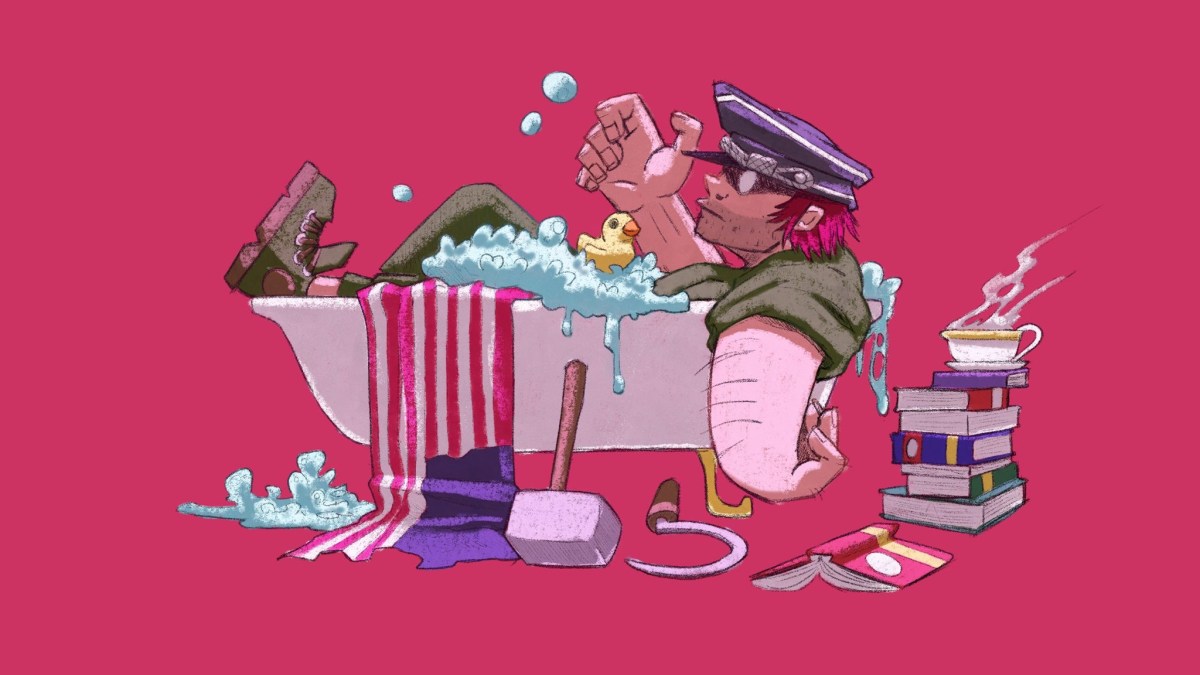
Original feature image art specially drawn by: TallCreepyGuy

While I work myself to boredom at a local retail store, I listen to some podcasts in the background. Something to cheer me up. Among my favourites are the Nature Podcast and Climate Denier’s Playbook. But, on that specific Wednesday, the episode was anything but cheering. I landed on the Nature Podcast’s “Trump team removes senior NIH chiefs in shock move” episode, which provided me with a bleak look into the current US administration’s proceedings. The bit that shocked me the most was how much the move clung to Project 2025‘s agenda. One of the moves discussed was a defunding of ‘gender ideology’ driven research (read anything that includes the word trans, even though such research is useful for everyone). Furthermore, instead of such ‘unimportant’ research, the administration wanted to conduct studies into ‘child mutilation’ (read trans conversation therapy) at hospitals. Eight hours later, while soaking in a mandatory afterwork bath, I began pondering “what is the interplay between extreme agendas and the ‘fall’ of science?” and “what I, a STEM person, could do about it?”. As a Polish person, my first bubbles of ideas started with fascism and the Third Reich.

Jews, fascism, and ‘directed’ science

I moved to the UK when I was twelve years old. This event spared me the traditional trip to Auschwitz one takes when in high school. It spared me from the walls scratched by the nails of the people trapped in gas chambers. It spared me from the place so horrible yet so pristinely preserved that visiting it is as close to time travel as one can get. About a fifth of the population of Poland was wiped out in World War II. On average, every family lost someone. Not on average, many families were completely gone. Due to the gravity of the topic at hand I reached out to Dr. Martin A. Ruehl, lecturer in German Intellectual History at the Faculty of Modern and Medieval Languages at University of Cambridge for some guidance. He also gave a talk on “What is fascism?” during the Cambridge festival, which I recommend. Another reason is that I am by education, a physicist, and just as physicists have their own set or rigorous habits that make their field solid, historians and philosophers have theirs.

Fascism as an idea is fuzzy, or at least with fuzzy borders. One knows definitely that after Hitler took over the power in Germany, it took on Fascist ideology. It is also abundantly clear that the current UK is not a fascist regime. Trying to nail the border delineating the least fascistic and just about not fascistic regime is futile, complicated further by each regime having their own unique element. The process of how it festers and develops in a country is left for others to explain, and I encourage the reader to watch this video essay by Tom Nicholas on how to spot a (potential) fascist. I will go with the conclusion of Dr Ruehl’s talk. Fascism is a racist, nationalistic, extreme and violent idea that often puts the core group in a self-imposed theoretical attack from the outgroup. (e.g. Jews were an imagined threat to the German state, even though they weren’t). I procrastinate talking about subject matter to highlight two important points: Fascism is a complex topic that could be studied for lifetimes and consequently, I am not an expert. I have made my best attempt at giving it the due diligence it deserves.

Disclaimers aside, what was the state of science during Hitler’s reign? Let us set the scene. The role I’d like us to play is that of a scientist at the time. Let us imagine ourselves in 1933 Germany, right at the beginning of the Nazi reign. Nazi party made it rather clear: Either you, as the scientist, are ready to conduct research that aligns with the party’s agenda, or you’re out of academia. Unless you’re Jewish and known to be on the left of the political spectrum (historical pre-nazi left, although it would still include things like early transgender care, for example, as advocated by Magnus Hirschfeld), then you don’t get a choice. Physics Today has a nice article that contains the migration of selected physicists out of Nazi Germany, which I recommend having a look at. Similar goes for other branches of science. The crux of the situation is that if you are studying races or ballistics, you are more than welcome to stay. Hitler did recognise that only the most modern military equipment would allow for the Third Reich to wage war on everyone. Similarly, he did want to put his ideals onto the firm foundation of “cold and logical” science, even though at times that compromised the scientific process. For example, the creation of Deutsche Physik (which denied relativity) and the burning of books by the above-mentioned Magnus Hirschfeld. (As much as my past self would thoroughly disagree, trans people are a cold and logical conclusion of how messy biology can be. More so than arbitrarily dividing all of population into two buckets.)

The adoption of the idea of Social Darwinism (that fittest social groups survive) and the knowledge of what genes do (albeit well before the discovery of DNA structure and the ability to compare genomes) created the foundation of ignorance for ‘scientific racism’ and eugenics. That being said, there was more to it than the current state of not-knowing. According to the introduction of “Nazi Germany and the Humanities” edited by Wolfgang Bialas and Anson Rabinbach, “Creation of the hated Weimar Republic created a deep sense of malaise and resentment among the mandarins, who, for all their differences, had in common the belief that a “profound ‘crisis of culture’ was at hand””. To draw a conclusion, the loss of the war and a tense national atmosphere led to the development of such völkisch ideals way before Hitler’s regime touched the ground. To further quote, “many retained the illusion of intellectual independence”. The general sense of superiority also gave rise to books like Deutsche Physik, a work that opposed Albert Einstein’s work directly.

(Note from the author: Googling “Social Darwinism” will lead you to creationist videos by Discovery Science (A YouTube channel by Discovery Institute, a fundamental creationist think tank). They seem to be hooked on using the aforementioned atrocities to try to link Darwin, and his early understanding of evolution, to Satan and hence to him leading us away from God with his theory. It is worth mentioning that although it bears his name, Darwin did not play a role in coining or using the term.)

To summarise this section: The way the corrupt ideals spread into science and politics in Nazi Germany arose from discontent and false hope. It was more of a fork situation. Both the world of academia and politics took up the story of national threat and superiority due to high levels of discontent originating from the Weimar era, and while intertwined together, I think that the cross-influence only amplified the process. This resulted in academia and politics taking up both ideals independently, and simply supported each other in the downward spiral such as antisemitism.

USSR, Russia, and limiting scientific cooperation.

A nice cup of tea on the following day led to some more thinking about other regimes. Like a true ‘Brit’, I took out my teapot and with a cup of Earl Gray in a fancy Whittard porcelain in my hand, I drifted off again into another rabbit hole. This time instead of west, I dug the tunnel east.
An interesting tidbit from my past regards my primary school. The changing rooms in that place had an interesting design. If one were to pay enough attention, they would see a system of grooves in the floors that were meant to act as drainage. Why drain something from an indoor location? The changing room was meant to serve as an emergency field hospital in case of another war. The school turns out to be old enough to see some of the old soviet practices in its design. For those unaware, Poland was part of the Soviet bloc up until 1991. Just 12 years before my birth, and 13 before Poland joined the EU. So let us journey to the east and see what history has to teach us.

Stalin was a dictator, just like his Austrian-German counterpart. What is slightly different is the ideology that shaped the persecution of scientists at the time –  a different flavour of extremism. I could go on a rant about what Stalinist flavour of Marxism is, but just like Fascism, there are scholars who spend their lives studying it. I am not one of them.

Nevertheless, the parallels between the corruption of sciences in Fascist Germany and Stalinist USSR are rather staggering for such different ideologies. In Germany, anything considered Jewish or going against the greatness of the Aryan race was immediately cut out, while the rest was bent towards the leading political party’s view. Here it was much the same. The humanist subjects took the largest hit in independence, as those in Germany. Lysenkoism played a role in slowing down the genetics research in the USSR. Instead, what followed was an increase in Lamarckism (acquired characteristics are passed on, rather than typical natural selection). This then, possibly, contributed to agricultural decline, creating another subject of memes for the edgy GenZ.

This also led further to isolation of the scientists. While every now and then they would invite foreign scientists (as Feynman wrote in his letters, and let us be honest, this might have been because of his involvement in Los Alamos) the mingling of Russian scientists with the rest of the world was minimal. Did I forget to mention that geneticists were often executed for not agreeing with Lysenkoism? Science is a global endeavour for a reason. It needs way more manpower than any country alone has. A country can never be a fully independent branch, it will simply lead to a slow withering of progress.

To have a nice circular structure in this section and bring it back to my home: Attitudes can also persist after occupation. The Polish government made some unpopular moves in academia during the time of the PIS party. Polish academia uses a scoring system, where each publication in a journal grants you points. Each point tries to quantify your contribution to a field. So technically a biochemistry paper would give you points in both biology and chemistry. They started awarding more points for papers in Polish journals rather than international ones, alongside some mixing of awarding points in political sciences for publishing theology papers. This may be seen as a slight resurrection of the national pride in sciences which I despise so much (Springer Nature’s journals are always going to be my favourite to skim through).

So what?

My Eurocentric summary of history is probably boring you to death. Let us talk about the US. Trump! The name that makes my hair stand on the back of my neck. The similarity of what is currently happening in the USA really makes me think that history does indeed repeat itself.

Firstly, just like Lysenko and his anti-genetics, Trump decided to elect RFK Jr as the minister of HHS. A well known opponent of vaccines is in a position of hiring and firing researchers. The MAHA (make America healthy again) report included a lot of less-than-optimal healthcare research directions. RFK really believes in a mix of the terrain theory (that the terrain of your body i.e. fitness and nutrition, play THE most important part of your immune system) and miasma theory (covered in a previous article here, but basically a medieval theory on bad air making you sick). There are a whole host of reasons for a person to also point out that a recovering drug addict and brain tapeworm survivor does not make for a great leader for a health agency. To be a devil’s advocate though, he did come up as an environmental lawyer. Additionally, RFK supports removal of fluoride from water and has helped to spread misinformation about vaccines in Africa. He has a very tangible body count and actively harms populations.

Secondly, there are the topics from the headlines in the first section. It is clear that the current administration’s aims are not simply doing science to explore x, but rather confirming x under the guise of science. This is why 75% of scientists that answered Nature’s poll said that they are looking to move out of the USA. Additionally, in a piece by the New York Times, experts in Fascism are also moving away from USA. It is something that is now consequently causing the ‘brain drain’ in the USA and, ironically for an administration that is anti-China, hands over the scientific majority to China. (Whether you think that is good or bad, is up to you. I personally am neutral.) Additionally, the administration has already tried to block Harvard’s ability to admit international students which contribute heavily towards their income stream – all in retaliation for Harvard allowing students to express their right to free speech and protest in favour of Palestine. This is slightly more sneaky than executions and imprisonments. Nevertheless, in a capitalist society, it might be somewhat equivalent when the funding we all depend on goes dry.

Lastly, there is a difference I would like to point out. Regimes like the one above often arose from a dire need for a radical leader and major changes. The current administration is exercising what I would like to call stealth authoritarianism (as coined by Spectacles here). Gone are the days of having posters with long-nosed depictions of minorities that eat children on every street (although the ‘they eat the dogs’ moment was close enough for many). The current US president is using rather specialised and closed off social media to reserve their opinions to their most dedicated followers rather than the general public. We live in the age where the algorithm separates us. It is becoming ever less likely to encounter an opinion we disagree with out in the wild without searching for it. Executions are no longer needed to silence the critics, for as long as you have a devoted fanbase, the infectiousness of the internet can create a potent and numerous enough group to win the election.

The fact that someone can be so overtly against reality, so blatantly corrupt, yet at the same time can feed a mirage to the right people to get elected is the true curse of the modern information landscape. For me personally, it is the main reason why CUSAP and similar societies are more important now than ever before.

What can you do

Every good opinion piece should end with a call to action. I also don’t want this entire blog post to be a long way of saying “AAAA WE ARE ALL GOING TO DIE!!!”, because we most likely won’t.

  • If you are in the USA and courageous enough, protest. It should be easy enough to find one nearby. This is not the main recommendation. Police brutality has already made itself visible in the past month.
  • What you can do more safely is support local lobbying. Be prepared that democracy is not as accessible as it seems. Genetically modified skeptic has posted their experiences trying to vote down the requirement for schools in Texas to have the 10 Commandments in classrooms. It was not a pleasant experience, but organisation and support for lobbying individuals can go a long way. Even if it means bringing them food and supplies or sitting in to notify them when it is their turn to speak at meetings.
  • Vaccinate your family against misinformation. The emotions can run high when politics are involved, but perhaps you can connect one bit of their viewpoint to that kernel of truth that may help. My personal jab at right-wing oil enthusiasts is to connect it with their dislike of migration, as this is a likely result of climate change. (Yes, I don’t believe migration is bad, but they do. Sometimes, you have to engage one topic at a time.)
  • Join a group to lobby and promote critical thinking. Here at CUSAP we try to go beyond Cambridge; thus we welcome articles written by non-members. You can get in touch with us at the https://cusap.org/action/. Youth against misinformation is another one. Plenty more can be found online.
  • Most importantly, do not shut up. Speak up when you see fake news. Don’t get distracted by trivial problems. Call your local political governors, meet with them, email them. This goes regardless of which party they are associated with. Make sure that they know that the truth is what you support. (It goes without saying, as long as you feel safe to do so)
  • Lastly, for my own sanity: do not be nihilistic about how little significance one action or vote has. One vote can make a lot of difference when it is surrounded by a couple thousand more singular votes.

Fiscal Cakeism

Author: Andreas Kapounek (Treasurer and Sponsorships officer)

There are different ways to increase government revenue (a non-complete list):

  1. Tax more
  2. Grow the economy so the same percentage of tax leads to more revenue
  3. Borrow more

Nevertheless, it often seems like politicians neglect the economic realities that trade-offs between these three streams pose. 

Tax more? You run the threat of depressing economic growth (as you reduce the incentives to start or expand a business). This means you may end up with less revenue than with the previous, lower, tax burden. This becomes clear in the limit: in the extreme, a 100% income tax would remove any economic (!) incentive to pursue a job, likely leading to the loss of most jobs.

Borrow more? If the markets are led to believe that the government may not be as likely to pay back all of this larger amount of debt than they owed previously, they will ask the government to pay larger risk premiums to lend money to the government. In practice this means that the government will have to pay higher yields on government bonds, as perfectly illustrated by the recent hike in German “Bund” borrowing costs in response to the announcement to moderate the German debt brake to increase defense spending.

Paradoxically, the interplay between taxation and borrowing is what stumped some recent British governments: If you promise to cut taxes and keep expenditure the same, people will assume that you must borrow the difference, driving up borrowing costs. At the same time, if you promise to keep taxes the same but spend more, people will equally assume that you will have to borrow the difference.

So having explored the interplay between taxation and growth, we are left with one more way to fund expenditure: government debt. As the famous (well, in Austria at least) Austrian chancellor Bruno Kreisky said: “And when someone asks me what I think about debt, I tell them what I always say: that a few billion more in debt gives me fewer sleepless nights than a few hundred thousand unemployed people!” I believe most people agree with that statement in principle!

So why can more borrowing be bad? Borrowing can have adverse consequences, because it affects anyone in the country with debt. For example, it drives up the cost of mortgage repayments. Furthermore, it increases the cost of future government debt, making it harder (for example) to raise capital for urgent infrastructure repairs when needed. Or as John F. Kennedy (who might be more familiar to many readers of this blog than Bruno Kreisky) said, when advertising for more spending in economically robust times: “the time to repair the roof is when the sun is shining.

All sides of the political landscape seem to appreciate these concepts when convenient but forget about them and selectively moralize these principles when not. At face value, it can be hard to see a necessary connection between economic policy and political philosophy. Believing that more borrowing without the matching growth expectations or unfunded tax cuts drive up the cost of debt (bond yields) is neither right-wing, left-wing, libertarian, capitalist, communist, or centrist: it is the best model of reality we currently have. 

Least understandable about these moralist views on economics is that it seems as if we broadly agree on the goals we pursue in our economies: There is broad agreement that (other things being equal) more wealth is better than less wealth, better living standards are better than worse living standards, and a more equal income distribution is better than a less equal income distribution. I would broadly call these shared goals “good stuff”. Now, of course, there can be fervent arguments about the relative importance of these goals and this may be a legitimate driver of ideological differences. But surely, we should be opposed to any policy reducing all three and support policies improving all three goals.

There is strikingly much less political agreement on the goals pursued through social policy (people legitimately debate whether a more progressive or more conservative set of values is “better”). On contentious social issues such as reproductive rights, gun control, or school uniforms, people who differ in their political views often do not share a common set of policy goals.

But back to fiscal policy. What I would argue for, is a more honest approach to fiscal policy. It is perfectly legitimate to want to increase public services and equally legitimate to want to cut taxes if one has evidence that either measure may contribute to a more prosperous economy – but on this issue we really cannot have our cake and eat it. 

The discussion above has largely focused on taxing and borrowing, but has broadly neglected the size of the economy. To stay with our ill-fitting cake metaphor – perhaps, if we just grow the cake, there will be some to have and some to eat? There is! But growing the economy is hard and getting harder.

As our advanced economies have matured over the second half of the 20th century into the 21st, the technological advances required to support high growth have increased. While it may have been really fruitful to build the Channel Tunnel it would add almost no utility to the European economy to now dig another one. Inventing the iPhone added great value to the economy but “inventing” the iPhone 367 might only marginally grow GDP and living standards. This is also why China is outgrowing the West but is not projected to catch up in per capita terms anytime soon – as they approach the Western level, their growth rates are expected to flatline too. AI might change this logic – but for now, the iron logic of marginal returns is tightening its screws on economic progress. 

We should and can be honest about this – in some way, we can even be proud of this. Never in the history of humankind has there been a better time to be alive than today and it is objectively hard to improve the current situation quickly. 

There is hope: We are not in the dark about our progress. Economists have spent decades putting the concepts so amateurishly (and in an oversimplified way) articulated by me in this blog into formulas. These formulas do not quite have the predictive power of Newtonian physics (Einstein did away with that anyways!), and acting as if they were a perfect description of the world can be dangerous. While the mathematical modelling underlying classical economics is fantastically rigorous, many concepts have not been experimentally validated (but this topic may need to wait for another blog post). Furthermore, in no way should this blog post diminish alternatives to current economic theories when these alternative descriptions of the economy are model based, yield testable predictions, and these predictions turn out to be true when tested: in fact, I would argue one should be agnostic to dogma and ideology, and focused solely on accurately describing reality, making sure to update beliefs when new evidence arises. Progress should be guided by the scientific method and controlled experiments where possible – if someone serves a piece of cake to 1000 participants, which all proceed to have it and eat it, I might have to find new metaphors. Nevertheless, most current models are performing much better than random guessing at forecasting developments in our economy and are our best available tool to shape policy. 

Therefore, we do have means to make educated guesses about which policies may increase “good stuff” and which policies may decrease “good stuff”. Maximizing “good stuff” should guide our fiscal, monetary and economic policy – and nothing else.

Therefore, we should:

  1. Improve and verify our methods to forecast “good stuff” and create policies accordingly
  2. Apply these policies 
  3. Measure the effects and adjust policies accordingly

Misinformation in the Digital Age – Prof. Stephan Lewandowsky, Dr Jon Roozenbeek, Prof. Sander van der Linden

We welcome Professor Sander van der Linden, Dr Jon Roozenbeek and Professor Stephan Lewandowsky, our expert panel on misinformation in the digital age. We tackle questions including “how can we fight against misinformation?” and “how does fake news affect our society?”

Professor Stephan Lewandowsky, Chair of Cognitive Psychology at the University of Bristol, is an expert in cognitive science focusing on questions such as “what determines whether people accept scientific evidence?” and “how does misinformation persist and spread within society?” Dr Jon Roozenbeek is an expert on the interplay between the media and our construction of identity, as well as working extensively alongside Professor Van der Linden on novel methods for countering misinformation online.

Professor Sander van der Linden, Associate Professor of Social Psychology in Society at the Department of Psychology is also Director of the Cambridge Social Decision-Making Lab. Professor Van der Linden’s work focuses on the psychology of human judgement and how people form misperceptions of the world around them.

Alongside Dr Roozenbeek, Professor Van der Linden developed an innovative new method of combatting fake news online – “The Fake News Game”. Check it out here.

This talk was co-hosted by the Cambridge Scientific Society which aims to increase public exposure of new research and findings.